Mexico Welcomes Its Heritage Home While France Clings to the Absurd Notion It Owns Latin America’s Past
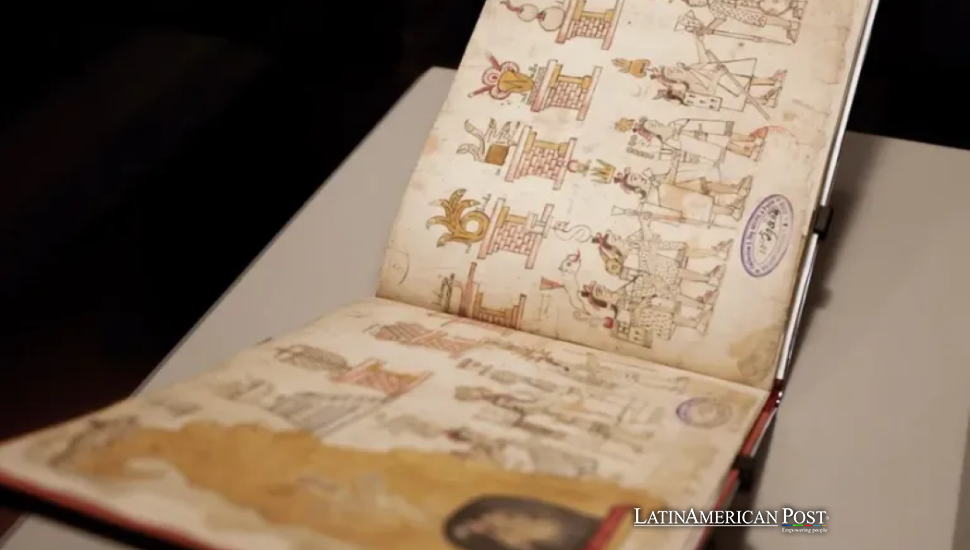
The Azcatitlan Codex has returned to Mexico on loan after 186 years abroad. Its temporary exhibition raises questions about ownership, Indigenous memory, and whether a celebration of friendship with France can resolve the manuscript’s long, unfinished history of changing hands.
A Homecoming With a Deadline
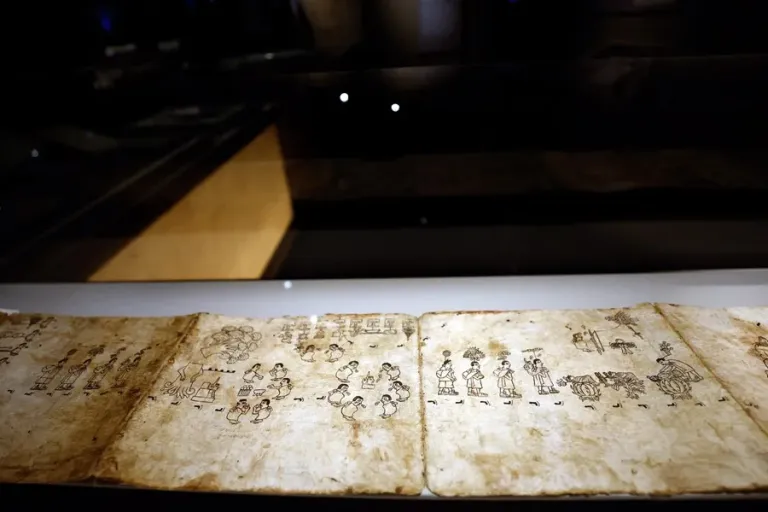
Acamapichtli sits on a throne covered with animal skin. Behind him rises a cactus rooted in stone, the sign of Tenochtitlan. Elsewhere in the same scene, a builder directs workers. The Azcatitlan Codex remembers not only rulers and military victories but the labor of making a city. Its pages have now returned to the valley whose history they preserve.
For now, it is visiting.
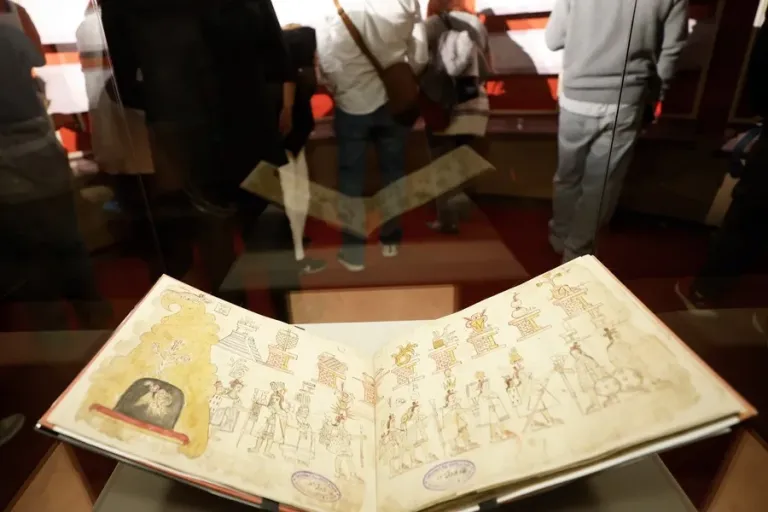
The manuscript went on display September 17 at Mexico City’s National Museum of Anthropology. EFE reports that the exhibition runs through December 31, 2026, as part of an exchange celebrating two centuries of diplomatic relations with France. Mexico’s Boturini Codex travels in the opposite direction. The agreement exchanges access to two manuscripts; it does not transfer ownership.
That distinction matters to Baltazar Brito Guadarrama, director of Mexico’s National Library of Anthropology and History. Speaking to EFE, he described efforts by the foreign affairs and culture ministries to recover documentary heritage. He hopes France will eventually donate the Azcatitlan Codex. “Work is underway,” he said, while acknowledging that the outcome depends on several factors.
His description makes clear why the exhibition is both a reunion and an unfinished negotiation. Physical presence answers where the manuscript can be seen this autumn. It does not answer where it will be kept afterward.
The object contains 25 folios of European paper, bearing a narrative that Brito says reaches across roughly 500 years of Mexica history. Those five centuries describe the story’s span, not a settled date for the manuscript’s manufacture. EFE places its creation between the sixteenth and seventeenth centuries, during the colonial period.
Its materials record that period’s cultural encounter. Indigenous pictorial conventions share the page with European forms of representation. Migration from Aztlán leads into the history of Tenochtitlan and the upheaval of Spanish conquest. This historical account was made after the world it describes had undergone profound change.
The narrative also preserves work, movement, and uncertainty. Routes connect settlements; rulers appear beside construction projects. Malintzin occupies a prominent position in a scene involving the Spanish arrivals. The manuscript is more than an illustrated succession of powerful men, although power and warfare remain central to its telling.
The migration sequence includes places identified as Chapultepec and Ecatepec, not just the departure point Aztlán. Dates, routes, and local features organize the story. The manuscript asks its reader to follow people across a landscape rather than admire an isolated object. That connection between a portable book and the places it records helps explain why a reunion with the original carries meaning beyond the exchange of exhibition loans.
Brito told EFE that manuscripts of this kind “belonged to the peoples,” explaining why individual authorship was not necessarily recorded. That account introduces a question different from the nationality of the institution holding the book. A community’s relationship with a historical record is not identical to a collector’s possession of it.
How a History Became a Collection
The route to Paris begins with uncertainty, not a complete set of receipts. A historical study published in the journal Ciencia identifies Indigenous scholar Fernando de Alva Ixtlilxóchitl as a possible early owner. He collected documents concerning the past while participating in colonial public life. The suggested connection is significant, but it remains a proposed link in the manuscript’s history.
The account then follows documents through Carlos de Sigüenza y Góngora and the Jesuits to Lorenzo Boturini, the Italian collector who assembled a substantial archive in New Spain. These were not interchangeable owners. Their collections formed through different scholarly projects, inheritances, and institutional relationships.
In 1743, colonial authorities confiscated Boturini’s collection and ordered his deportation. His later catalog described a history on 25 leaves of European paper covering Mexica migration, the Spaniards’ arrival and Christian evangelization. Published in 1746, that description provides a firmer documentary reference than the proposed earliest ownership.
It also complicates any tidy story of uninterrupted private possession. The collection had passed into colonial custody before parts circulated among later scholars and collectors. Knowing the next holder’s name does not necessarily explain the authority under which every transfer occurred.
Joseph Marius Alexis Aubin subsequently obtained the manuscript among the Indigenous documents he collected. He took his collection to France in 1840, the departure date reported by EFE and the historical account. The codex later entered the collection of Eugène Goupil, whose widow donated the archive to France’s national library.
The sale’s dating is inconsistent across accounts. EFE’s chronology gives 1830, but the study in Ciencia records Goupil’s signature on the manuscript itself, dated Paris, 1889. It also describes collection marks and French Republic initials on several pages. These physical traces identify later possession with a specificity unavailable for the unnamed people who originally painted the history.
EFE reports that the donation required preservation in that public institution. That condition helps explain the present custodial arrangement. It does not, by itself, establish whether every earlier transaction complied with the applicable rules or reflected the wishes of the communities whose history it recorded.
The distinction cuts both ways. These accounts do not establish a judicial finding that France stole this particular manuscript. Neither does the existence of a later donation settle every question about its removal. Provenance identifies a route; assessing ownership requires examining the circumstances along it.
France’s contribution to scholarship is also documented. Its national library and the Société des Américanistes published a facsimile and commentary in 1995, in French and Spanish. The manuscript’s history abroad therefore includes reproduction and research, not simply confinement beyond Mexican readers’ reach.
French public property law adds another constraint: protected public holdings generally cannot simply be sold or given away. Lending an object is different from relinquishing it. That rule does not, by itself, establish which legal mechanism might apply to this codex, and the reported exhibition agreement contains no announced transfer.
For Brito, the desired next step is donation. That would be a different arrangement from the one already negotiated, not simply another word for the current loan.
The Readers Beyond the Capitals
The figures Brito gave EFE show why individual manuscripts attract attention. He estimated about 600 codices of this tradition worldwide, with more than 100 held in France, along with other valuable copies. Of those, France holds more than one in six.
He also cited nearly 35 percent of the holdings as belonging to the French and Mexican national libraries. Applied to 600, that represents roughly 210 manuscripts. The report supplies no detailed inventory or separate institutional breakdown, so the percentage cannot responsibly become a precise count for either library alone.
The numbers indicate concentration, not the circumstances of acquisition. They cannot establish how many documents were unlawfully removed. Nor does returning one codex mechanically resolve the status of others, whose histories may differ. What changes immediately is access to that particular original.
A Mexican visitor who can now reach the museum has an opportunity that previously required access abroad. Keeping the original in Mexico would alter that geography over time. But location alone would not determine who could study it, which communities would shape its interpretation, or how much public access conservation would allow.
The same distinction applies to the word “return.” A permanent transfer would change institutional control. A longer loan could extend physical access without changing ownership. Reproductions could circulate under either arrangement. These possibilities answer different questions, even when diplomatic language places them together under cultural cooperation.
The bilateral setting can also obscure another relationship. In separate reporting, Reuters quoted María Eugenia Castañeda, identified as a representative of the Mexica peoples, emphasizing the codices’ continuing importance for identity, customs, and cultural confidence. Her comments concerned living people, not only the historical prestige of either national collection.
That raises practical questions about permanence. Would Indigenous researchers and educators participate in interpretation? Would access extend beyond visitors able to travel to the capital? Who would help determine how the record is presented? The reporting does not describe such arrangements, and a change of national custody would not automatically supply them.
President Claudia Sheinbaum called the codex Mexico’s “living memory” and also “the deep root of our identity” during Emmanuel Macron’s November 2025 visit, EFE reported. Brito’s hoped-for donation would give that cultural claim a new institutional expression. The existing exchange, however, demonstrates cooperation over display without announcing agreement on permanent possession.
The distance between those outcomes is the substance of the question, not a technical footnote. France holds a particular manuscript; that is different from owning the cultural past recorded within it. Mexico is receiving the original for fewer than four months after 186 years abroad. For now, the arrangement brings the book back without deciding whether coming back can become staying.
Also Read: Uruguay Seeks Carlos Gardel Birthday Tribute as His Birthplace Debate Dances On