Great Britain Digs In as Milei Turns Malvinas Oil Into Leverage Again

Argentina’s Malvinas dispute with Great Britain is entering a sharper phase as Javier Milei targets oil companies, promises a southern naval base, and embraces Donald Trump’s diplomatic opening, transforming an old sovereignty claim into a contest over resources and power.
An Old Dispute Finds New Fuel
For more than four decades, the Malvinas have lived in Argentina as something larger than geography. They are printed on school maps, invoked at football matches, remembered through the dead of the 1982 war and embedded in a national vocabulary of territory lost but never relinquished.
Now President Javier Milei is trying to move that claim into a different arena.
His government says companies involved in exploiting natural resources around the British-controlled islands without Argentine authorization will be barred from operating in Argentina. Milei also plans legislation extending penalties to shareholders, executives and suppliers, while promising an integrated naval base in Tierra del Fuego, the Argentine province whose official territorial definition includes the islands.
The response from Great Britain was immediate and unusually blunt.
Britain’s commitment to the islands is “absolute and unwavering,” Defense Minister Wes Streeting said, dismissing Milei’s rhetoric as more reflective of Argentine domestic politics than conditions in the South Atlantic.
London returned to the argument it has relied upon for years: self-determination. In the 2013 referendum, 99.8 percent of participating islanders voted to retain their status as a British Overseas Territory, with only three votes against.
Downing Street reinforced that position. A British government source told the BBC that self-determination also includes the islanders’ right to exploit their natural resources.
There lies the immediate problem. This confrontation is no longer only about flags.
It is increasingly about what lies beneath the sea.
Milei specifically singled out the oil project involving Israel’s Navitas Petroleum and Britain’s Rockhopper Exploration, which could open a new chapter in commercial petroleum production around the archipelago. Argentina previously sanctioned Rockhopper in 2013 and Navitas in 2022.
“If we do not act firmly and quickly today,” Milei warned, companies could soon gain the material capacity to appropriate petroleum reserves beneath what Argentina considers its waters.
That changes the political clock. Sovereignty disputes can remain frozen for generations. Oil fields cannot.

Tierra del Fuego Becomes the Chessboard
Milei’s proposed naval base gives the confrontation a physical dimension.
The president says additional Defense Ministry resources will prioritize construction of an integrated base in Tierra del Fuego, turning Argentina’s southern extremity into what he called the most important logistical hub in the South Atlantic.
That language reaches beyond the Malvinas.
Milei connected the islands to maritime security, Antarctica and an approaching global competition for resources needed to sustain artificial intelligence and technological growth. In his telling, the South Atlantic is becoming strategically valuable precisely when Argentina believes the international balance may finally be moving in its favor.
The calculation contains recognizable Argentine history. Buenos Aires has long regarded Patagonia, the South Atlantic, the Malvinas and Antarctica as parts of an interconnected geopolitical space. What is different is Milei’s attempt to combine that traditional sovereignty doctrine with his aggressively pro-American foreign policy.
For a president who built his international identity around alignment with Washington, the Malvinas present an obvious contradiction. The country occupying the islands is Great Britain, one of America’s closest historical allies.
Milei believes Donald Trump may provide a way through it.
Trump recently said Washington was reviewing its position regarding the dispute. Milei seized upon the remark, calling the Malvinas Argentina’s “most important and sacred” national cause and presenting his alliance with the United States as the possible “key” to recovering them.
Yet caution is necessary. The American ambassador in Buenos Aires, Peter Lamelas, subsequently said U.S. neutrality had not changed. Washington has historically recognized British administration while avoiding endorsement of either country’s sovereignty claim.
That gap between Trump’s suggestive language and formal American policy is enormous.
Still, diplomacy often moves first through ambiguity. Milei clearly senses an opening and is trying to widen it before it closes.
His argument is audacious: Argentina can make itself so strategically useful to Washington that the geopolitical value of Buenos Aires eventually outweighs automatic American deference to London on the South Atlantic question.
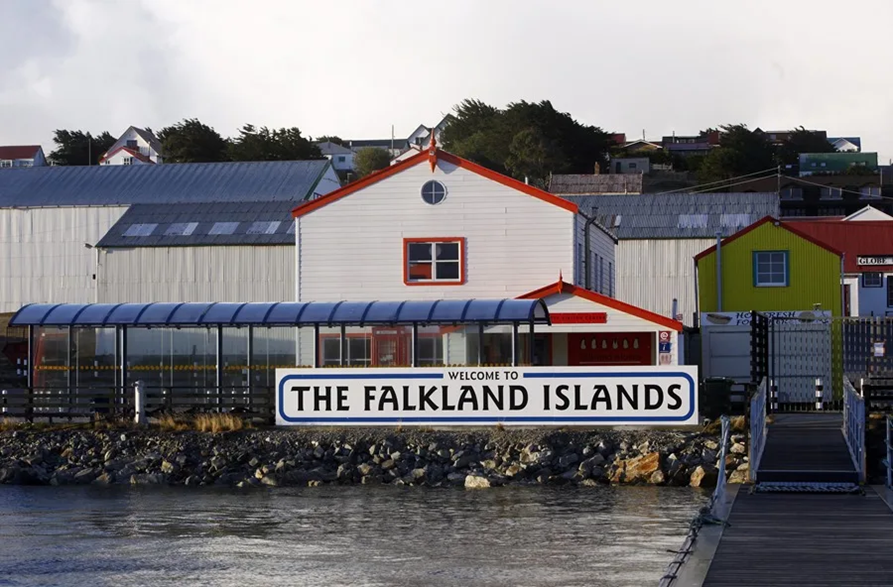
The Malvinas Return to a Changing World
Milei went further by describing Great Britain as a country suffering migration, demographic and economic crises and traveling along a path of “decline.” His language closely resembles Trump’s recurring attacks on European weakness.
It is also revealing.
Argentina lost the 1982 war catastrophically. The military junta’s invasion ended with surrender after 74 days of fighting and hundreds of Argentine and British deaths. For generations afterward, the power imbalance seemed immovable.
Milei is effectively arguing that time itself could alter that equation.
Not through another war. He has repeatedly emphasized diplomacy. Rather, through economic pressure, military modernization, American alignment and the changing strategic importance of the South Atlantic.
The oil question makes that strategy more urgent. Fisheries already underpin much of the islands’ economy, alongside tourism and sheep farming. Petroleum could provide another economic foundation and deepen the material permanence of British administration.
That helps explain why Milei is targeting companies rather than islanders. Preventing firms from participating simultaneously in the Argentine mainland economy and unauthorized Malvinas projects creates a choice that Buenos Aires can actually enforce.
Whether the threat carries enough economic weight is another matter. Britain administers the territory. Argentina claims sovereignty. Neither legal position disappears because a corporation loses access to one market.
The deeper contest is therefore about permanence.
London points to the people who live there and asks what they want. Argentina points to history, geography and the British occupation dating from 1833 and asks how the population created under that administration can settle the underlying sovereignty dispute.
Neither argument is new.
What is new is the world surrounding them.
Antarctic access, offshore energy, maritime routes and strategic competition are making the southern oceans harder to treat as peripheral spaces. Milei appears determined to exploit that transformation while his relationship with Trump is unusually close.
Great Britain, meanwhile, is signaling that there is nothing to negotiate about the islanders’ political future unless they want negotiation themselves.
So the Malvinas dispute enters another chapter with an old cemetery still overlooking the South Atlantic and new oil calculations beneath its waters.
For Argentina, the islands remain memory made territorial. For Great Britain, they remain a question of political choice by their inhabitants. For Milei, increasingly, they are also about the future.
And that may be the most consequential change. The argument over the Malvinas is no longer being fought only over what happened in 1833 or 1982. It is being repositioned around what the South Atlantic could become.
Also Read: Peruvian Gang Los Pulpos Stretches Its Tentacles Across South America