Latin America Watches Washington Turn Migration Into a Retro Arcade Game Again
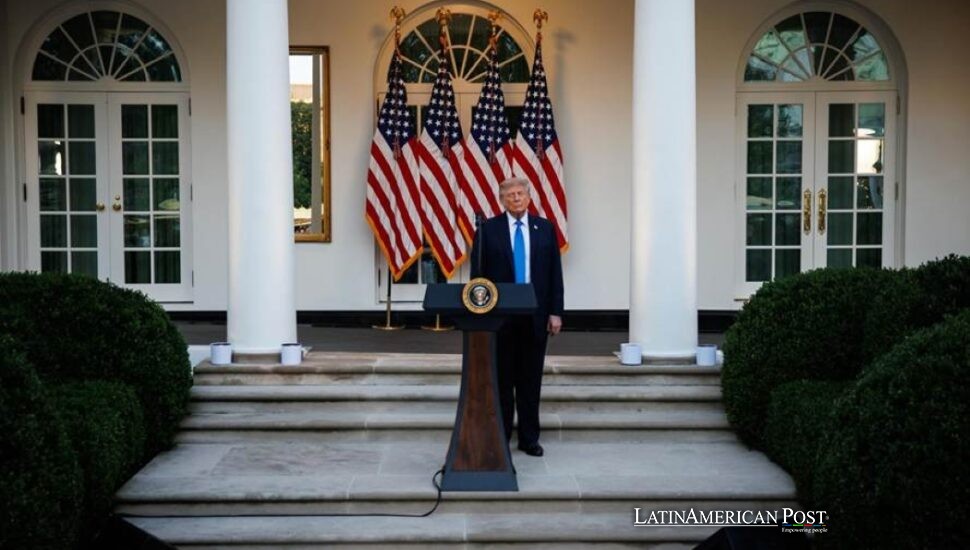
The White House has turned border enforcement into pixelated entertainment, letting players build walls and chase migrants for points. For Latin America, where migration carries histories of poverty, violence, separation and death, the joke exposes something more troubling than bad taste.
When State Power Becomes a Game Mechanic
Somewhere between the Rio Grande and a computer screen, a human being has become a pixel.
The White House this week launched Arcade.gov, a collection of retro-style video games designed to turn Donald Trump administration policies into interactive entertainment. One asks players to build the border wall. Another sends them patrolling the Rio Grande, pursuing people attempting to cross into the United States.
Finish the game and those people are counted as deported.
That detail is the heart of the problem.
This is not simply political humor, clever digital outreach or another example of the Trump administration’s talent for provocation. It is the conversion of government coercion into a reward system. Deportation, one of the most consequential powers a state can exercise over a noncitizen, becomes a score.
The aesthetic makes that transformation easier to miss. The games borrow from Tetris, Snake, Tapper and Flappy Bird, the visual language of old consoles and childhood afternoons spent chasing high scores. Promotional animations parody PlayStation and Nintendo loading screens. Sega’s familiar logo becomes MAGA.
The slogan is cheerful: “Can’t stop winning.”
But governments are not video game studios, and immigration enforcement is not an imaginary contest.
“Build the Wall” asks players to assemble barriers to “protect the border from the approaching horde,” according to the official description reported by EFE. “Rio Run” turns people crossing the river into moving targets to be intercepted, after which a deportation counter records success.
The central objection is not that Washington favors tougher immigration enforcement. A sovereign state can defend stricter border controls. Voters can support deportations. Governments can build barriers.
The problem begins when the state turns the people subjected to those policies into game pieces and makes their removal entertaining.
Serious government requires something entertainment does not: recognition of consequence.

The Border Is Not an Eight-Bit Abstraction
From Washington, the border can be rendered as a line to defend.
Across Latin America, migration is more often experienced as an absence.
It is the empty chair at dinner in Guatemala. The mother in Honduras waiting for a voice message from Texas. The Mexican child raised by grandparents while a parent works north of the border. It is a remittance received every month from someone whose physical presence disappeared years ago.
Migration has become part of the social architecture of entire communities.
That does not make every migrant legally entitled to enter the United States. It does make the phenomenon too serious to flatten into a chase game.
The United States has legitimate problems to solve: unauthorized entry, asylum backlogs, trafficking networks, labor demand, border security and the limits of enforcement capacity. These issues are difficult because they involve conflicting obligations and enormous numbers of actual people.
A game such as “Rio Run” removes every difficulty.
There are no asylum hearings. No frightened children. No border agents making judgment calls. No traffickers. No distinction between a family seeking protection and someone crossing for purely economic reasons. No question of law, evidence or proportionality.
There is only movement, pursuit and elimination from the screen.
That is what makes the format politically significant. Games require clarity. There must be an obstacle, a player and a definition of victory.
Migration is almost nothing but ambiguity.
The Rio Grande, known in Mexico as the Río Bravo, also carries a reality that cannot be reduced to nostalgic pixels. People drown there. Families lose relatives along migration routes. Some bodies are identified. Others are not.
Against that reality, the phrase “approaching horde” is not harmless decoration.
It strips individuals of biography and turns them into a mass. Once migrants are imagined primarily as a swarm moving toward the player, their circumstances no longer matter.
That is useful for propaganda because complexity interferes with emotional certainty.
The teenager fleeing gang recruitment and the trafficker moving contraband cannot be understood as the same person. Neither can an asylum seeker, an agricultural worker overstaying a visa and a family entering without authorization.
A serious immigration system must distinguish between them.
A video game needs only one button.

The Real Cost Is the Trivialization of Power
The White House told the Washington Examiner that Arcade is intended to translate Trump’s agenda into an interactive format and tell the story of the administration’s achievements in a way that connects with Americans.
That explanation should be taken seriously.
The administration is not hiding the purpose. It is deliberately converting public policy into entertainment because entertainment travels faster than policy.
That is precisely why the exercise deserves criticism.
Modern politics already rewards simplification. Policies become memes. Presidents become brands. Wars, tariffs, deportations and economic programs are packaged for social media in formats designed to provoke before they explain.
Arcade.gov takes that logic one step further.
It does not merely advertise policy. It asks the citizen to simulate enforcement and experience the policy as victory.
There is a game about removing foods that fail the administration’s Make America Healthy Again standards. Another involves savings accounts for children. A bald eagle flies above the National Mall in another.
Those subjects can withstand playful treatment because the player’s success does not require imagining another human being’s expulsion as a reward.
Deportation is different.
The machinery of immigration enforcement includes arrests, detention, legal proceedings, transportation, family separation, asylum adjudication and return to countries where people may have spent years trying to escape poverty or violence.
A government may conclude that deportation is legally necessary.
Necessity is not the same as amusement.
That distinction is what Arcade.gov erases.
Latin America deserves scrutiny too. Governments across the region have helped create migration through corruption, weak institutions, criminal violence, economic exclusion and decades of failure to provide citizens with credible futures. Washington did not invent the reasons people leave Honduras, Haiti, Venezuela or Guatemala.
But American border policy interacts with those failures at the moment when human beings reach the United States.
That moment demands law and judgment, not a victory screen.
The danger of Arcade.gov is therefore not that a retro game will determine immigration policy.
The danger is that it teaches citizens how to feel about the people subjected to that policy.
If detention becomes spectacle, deportation becomes a score and migrants become an “approaching horde,” the moral distance between state power and its consequences becomes easier to maintain.
That distance matters in a democracy.
Governments possess extraordinary authority precisely because they are expected to exercise it with more seriousness than a campaign rally, meme account or video game.
A border can be defended without turning migrants into targets.
A deportation policy can be argued without making removal playful.
A government can be firm without becoming frivolous about the people over whom it holds power.
For Latin America, that is the deeper insult in Arcade.gov. It takes one of the hemisphere’s most painful social realities, built from fractured families, dangerous journeys and decades of unequal opportunity, and reduces it to nostalgic graphics and a score counter.
Somewhere beyond the screen, the river is still real.
So are the people crossing it.
Also Read: Trump Claims Latin America’s Right Turn, but Voters Wrote It