El Salvador Faces a Homeland Crisis as TPS Ends for Thousands Abroad

More than 170,000 Salvadorans in the United States could lose legal protection on September 9, turning a bureaucratic deadline into a family rupture. For many, El Salvador is less a homeland than a country inherited through documents, stories, and fear.
When Temporary Status Becomes a Lifetime
Alma remembers being lifted onto a chair so immigration officers could take her fingerprints.
She was little enough to think it was a game.
Only years later did she understand what was happening. The officers were collecting biometric information for the immigration protection that would shape nearly every year of her life in the United States.
“I grew up with TPS,” Alma, now 30 and living in Missouri, told EFE. She asked that her last name not be published because she fears retaliation.
She arrived in the United States when she was 18 months old. Her mother obtained Temporary Protected Status for both of them after El Salvador was designated for the program in 2001. Alma went to school in America, bought a house, built a career and became a supervisor at the company where she works.
She has no memories of El Salvador.
Yet on September 9, the legal status that allowed her to construct that life is scheduled to expire.
“I grew up with an American life, with American values,” she told EFE. “Why do they want to take us out?”
Her question exposes the strange contradiction at the heart of TPS. The program was created as temporary protection, but temporary can acquire an entirely different meaning when it lasts a quarter-century.
A five-year-old becomes 30. Workers become supervisors. Renters sign mortgages. Children are born. Parents die.
The immigration category remains temporary even when the human life built beneath it becomes permanent.
For approximately 170,000 Salvadorans, according to figures cited by the National Immigration Forum, expiration means losing work authorization and legal permission to remain in the United States. For some, old deportation orders suspended while they held TPS could become active again.
The word officials may use is return.
For Alma, it does not feel like one.
“When people tell me, ‘go back’ to El Salvador, for me it isn’t going back to a life because I didn’t live there,” she told EFE.
That distinction is more than emotional. It is the central difficulty of treating migration as though geography alone determines belonging.
A Generation Built Around an Expiration Date
José Palma has spent years living with the same uncertainty.
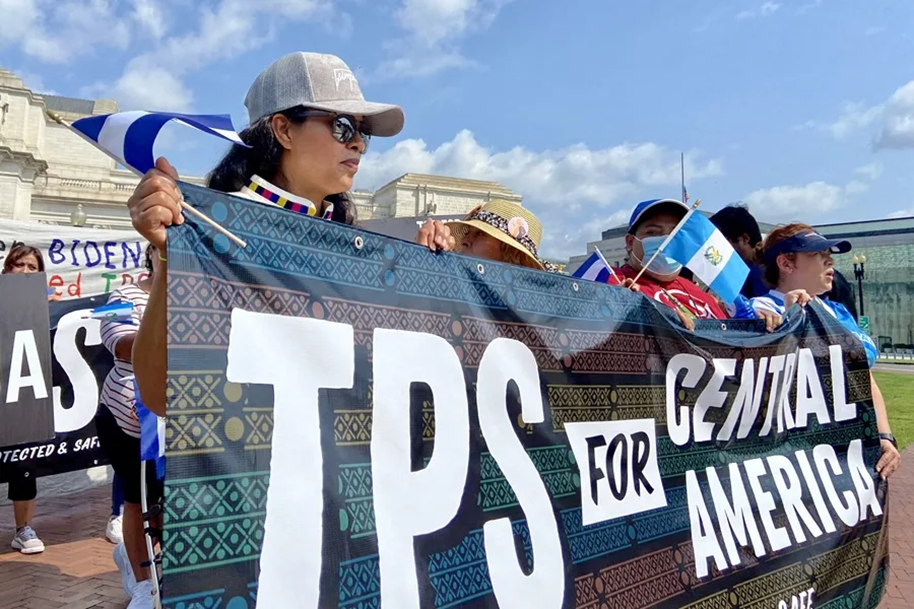
The 48-year-old coordinator of the TPS Alliance, a coalition formed in 2017 to advocate for permanent legal status, is the father of four U.S. citizens. He told EFE that the approaching deadline has already changed how his family lives.
A construction project at his house has been stopped. Spending has been cut. Money is being saved for whatever comes next.
TPS holders have learned to live with documents that must be renewed and futures that cannot quite be guaranteed.
“We would have applied a long time ago,” Palma told EFE of permanent residency. “Who wants to live without knowing what will happen with their future?”
That question becomes harder after 25 years.
Many Salvadoran TPS beneficiaries have become deeply integrated into local economies. Migration and human rights expert Celia Medrano told EFE that many have lived legally in the United States for more than two decades, speak English, hold jobs, pay taxes, own homes or carry mortgages and have their immediate families around them.
She estimated typical annual incomes among beneficiaries at between $40,000 and $50,000.
Those details matter because deportation is usually imagined as the movement of an individual across a border.
In reality, it can dismantle an economic unit.
Alma’s employer in Missouri is preparing to lose workers who have been there for years, some since 2001. Their jobs will eventually be filled. The factory will continue operating.
That continuity troubles her.
“It hurts to see how life will keep flowing and they will be replaced,” she told EFE, while the people losing TPS leave “with nothing.”
There is another population hidden behind the 170,000 adults.
Medrano estimates that roughly 150,000 children and adolescents whose Salvadoran parents hold TPS could be affected. Many were born in the United States and are American citizens.
The expiration of one parent’s immigration status can therefore create choices no child made: separation from a mother or father, relocation to a country the child may never have visited, or a divided household stretched across borders.
Migration statistics rarely capture that geometry.
One deportation can create several forms of displacement at once.
Returning to a Country That Has Changed
El Salvador itself presents another complication.
The country to which TPS holders may be sent is not necessarily the country they left.
Medrano warned that reintegration could be difficult because beneficiaries have built economic and social lives under very different conditions. She told EFE that returning Salvadorans may encounter high unemployment, rising poverty and a labor market in which more than 60 percent of the economically active population works in the informal sector.
For someone who has spent 20 or 25 years earning a U.S. salary, maintaining a mortgage and working inside a formal employment system, that adjustment is not simply cultural.
It is structural.
A person can speak Spanish, carry a Salvadoran passport and still arrive as something close to a stranger.
That is the deeper paradox facing the country.
El Salvador has spent generations exporting people. Migration became an economic survival strategy for families and, through remittances, an important pillar of national life. Yet the possibility of mass forced return raises questions about whether the country can absorb people whose skills, expectations, children and financial obligations were formed elsewhere.
Medrano argues the Salvadoran government should prepare for that possibility now.
There is also the question of civic reintegration. She warned that many Salvadorans remain reluctant to express political opinions publicly for fear of consequences, a climate that could feel unfamiliar to returnees accustomed to different forms of political participation in the United States.
None of this means TPS was intended to last forever.
That is precisely the problem.
Successive American governments allowed a temporary humanitarian program to become the legal foundation for entire adult lives without creating a durable solution for many of the people living under it.
Alma’s mother waited for one.
She died before it came.
Now her daughter is still waiting.
The September 9 deadline will be described in official language as the expiration of a migration benefit. For Alma, Palma and thousands of families, the experience will be less administrative.
It will be a test of what the word home actually means after 25 years.
El Salvador may be written on their birth certificates.
But America is where many learned to read them.
Also Read: Venezuela Earthquake Pets Wait Behind Bars for Families to Return