Mexico’s Zombie Fungi Turn Ants Into Living Del Toro Nightmares
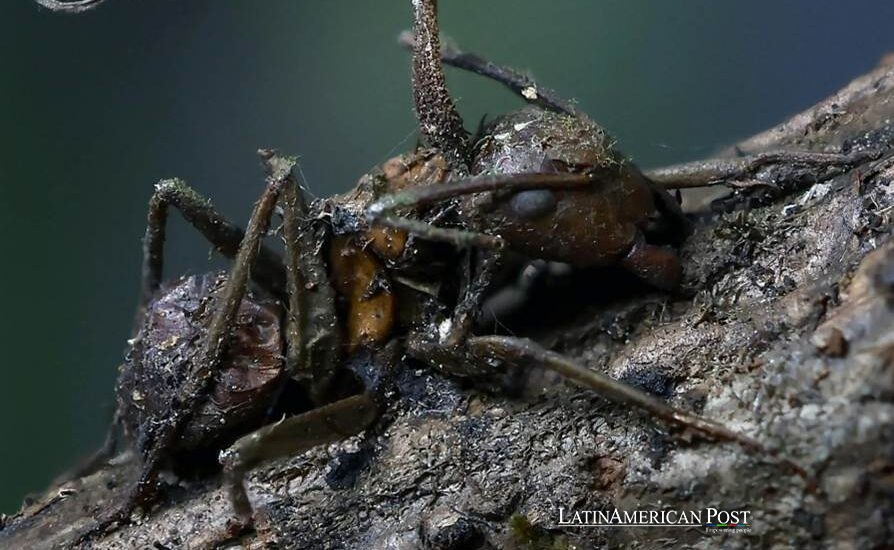
In Jalisco’s tropical forests, six newly documented fungi hijack ants, steer them toward humid graveyards and grow from their bodies. The discovery gives Mexico a scientific first, honors Guillermo del Toro, and opens a strange path toward possible future medicines.
A Forest Where the Dead Keep Growing
In Jalisco’s humid forests, an ant begins to walk as if no longer in control.
Its path turns erratic. It leaves the routes that usually bind a colony together and moves toward a place selected not by instinct, but by an organism growing inside its body. There, beneath a leaf, against tree bark or under a rock, it clamps down with its mandibles and legs. Then it dies.
For the fungus, that death is not an ending. It is the beginning of a reproductive stage engineered through the ant’s final movements.
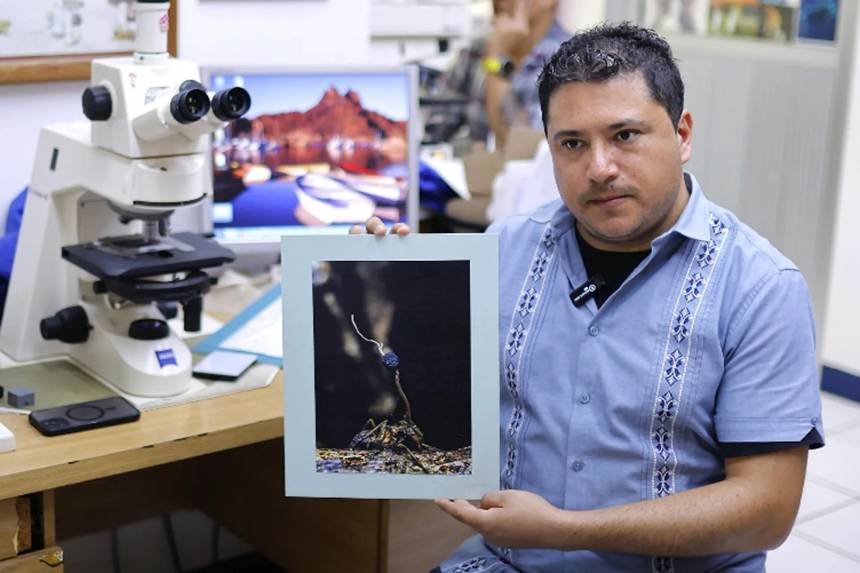
César Ballesteros, a researcher at the University of Guadalajara, documented six species of these entomopathogenic fungi in Jalisco’s tropical forests. The organisms infect ants and spiders, invade their bodies and alter their behavior through specialized metabolites that interact with the nervous system.
“When it enters the ant’s body, it begins to produce a substance that changes how the insect behaves, Ballesteros explained in an interview with EFE. The infected ant starts moving unpredictably until the fungus directs it toward the precise light and humidity conditions needed to survive.
Scientists sometimes call these sites cemeteries because insect carcasses accumulate there. The name sounds theatrical, but the mechanism is exact. The ant’s body becomes shelter, scaffolding, and food. Its skeleton anchors the fungus in a position from which it can grow and release spores, increasing the likelihood of reaching another host.
The horror lies in the loss of control. The beauty, Ballesteros suggests, lies in the precision.

Guillermo del Toro Gets His Own Monster
One of the newly documented species now bears the name Ophiocordyceps deltoroi, honoring filmmaker Guillermo del Toro, another son of Jalisco whose work has spent decades finding tenderness, tragedy and visual splendor inside monsters.
The tribute is unusually fitting. Del Toro studied at the University of Guadalajara, and his films have repeatedly treated monstrous bodies not as empty threats, but as complicated worlds. Ballesteros told EFE that a so-called zombie fungus resembling creatures from the director’s imagination offered the perfect scientific homage.
The naming also places Mexican culture inside taxonomy, the system through which science records life. Latin American species have often entered global collections under names chosen far from their landscapes. Ophiocordyceps deltoroi closes that distance. A Jalisco fungus now carries a Jalisco storyteller’s name.
Popular culture has prepared audiences for this unsettling logic. The video game and television series “The Last of Us” imagine a cordyceps-like infection crossing into humans. The real fungi offer no evidence for that scenario. Their biology is quieter and stranger, unfolding among insects for centuries.
The fungus does not need intelligence in the human sense. Natural selection has refined a chemical and behavioral sequence that places the dying host where fungal reproduction is most likely to succeed. What looks like possession is a survival strategy.
Calling the ants zombies makes the science memorable, but it can hide the ecological sophistication underneath. Parasite, host, humidity, and surface form one linked system. Without the right microclimate, the manipulation no longer pays off.
Six Species Rewrite Mexico’s Fungal Map
Ballesteros called the discovery a milestone because these are the first species of their kind formally described in Mexico. Before this work, the country had only one recorded species in the group, Cordyceps mexicana, known for attacking butterflies.
Now six species exclusive to Mexico enter the scientific record.
The sudden increase does not mean the fungi recently appeared. It reveals how much remained unseen. Ballesteros said very few specialists can identify and study them. Mexico’s fungal map, in other words, has been limited not by a lack of biological richness, but by a lack of trained eyes devoted to documenting it.
That gap matters. A species without formal description is harder to protect, compare, or study. It can disappear with a forest before science assigns it a name. As tropical ecosystems face land conversion, infrastructure and climate pressure, taxonomy becomes more than classification. It establishes what exists while it still can be found.
The discovery also complicates the usual hierarchy of charismatic conservation. Jaguars, monarch butterflies and ancient trees command attention. Fungi working inside small insects rarely do. Yet these organisms help regulate populations and reveal how deeply evolution can connect one species’ life cycle to another’s behavior.
Their chemistry may also have practical value. Ballesteros told EFE that compounds produced by some fungi could eventually be investigated for medicines related to cancer, tuberculosis, multiple sclerosis and other diseases. That possibility should be treated as a research horizon, not a ready cure. Isolating a substance, proving that it works, and developing a safe treatment are very different stages.
Still, the medical potential strengthens the case for studying biodiversity before it vanishes. A discarded patch of forest may contain organisms whose ecological role is only beginning to be understood and whose chemistry has never been tested.
In Jalisco, the story begins with an ant making its last climb. It ends, for now, with six new names, a filmmaker’s monster preserved in Latin, and a reminder that Mexico’s forests still contain dramas more intricate than fiction.
Also Read: Cuba Opens Solar Charging Station Amid Its Deepening Power Crisis