Dominican and Puerto Rican Stars Bring New York Knicks Glory
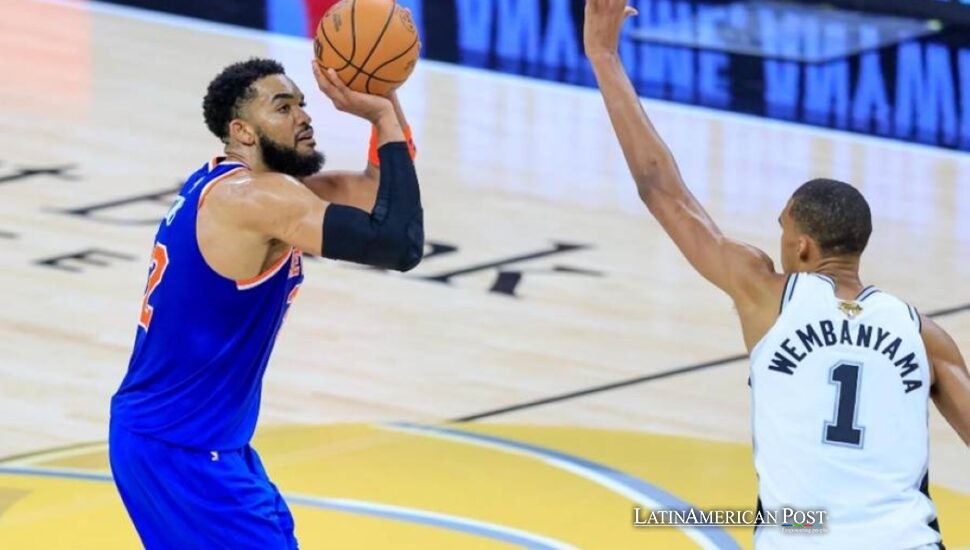
Karl-Anthony Towns and Jose Alvarado turned the New York Knicks’ 2026 NBA championship into a Caribbean homecoming, carrying Dominican and Puerto Rican identity through a 53-year drought while redefining hometown glory across New York’s sprawling Latino diaspora today and beyond.
The Box Score Could Not Hold the Moment
At the Frost Bank Center in San Antonio, the last box score looked almost mischievous. Towns scored two points, grabbed 10 rebounds, and fouled out. Alvarado missed all five shots and finished scoreless in 11 minutes. Jalen Brunson poured in 45. Yet after New York’s 94-90 victory sealed the series 4-1, the photographs told another truth. Towns found his family. Alvarado wrapped himself in Puerto Rico’s flag and held the Larry O’Brien Trophy like he was carrying it through a Brooklyn block party. The Knicks had their third championship, following 1970 and 1973, and two U.S.-born sons of the Caribbean stood inside the long-awaited picture.
Professional sports explain triumph through numerical hierarchy: points, minutes, salaries, and awards. Cultural meaning rarely obeys. Towns and Alvarado did not need to dominate Game 5 to change what the championship represented. Their routes into that room had already made the night larger than the final possessions.
Towns, 30, arrived as the decorated one. A former No. 1 pick, six-time All-Star and rare seven-foot shooter, he spent nine seasons in Minnesota before returning near home. He grew up in New Jersey, less than an hour from Madison Square Garden, and followed the Knicks as a boy. During the title run, he produced the highest total plus-minus in a single NBA postseason, at plus 258. Through the Finals’ first two games, he averaged 19.5 points, 12.5 rebounds, and four assists while repeatedly defending Victor Wembanyama. Then came the quiet closeout. Championships often ask a star to be central for weeks, then accept being carried for one night.
His homecoming also carried an absence. Towns dedicated the postseason to his late mother, Jacqueline Cruz, whose Dominican roots shaped his public identity and whose death from COVID-19 transformed his life. After the final buzzer, he embraced his father and fiancée. There was joy in the scene, but also the outline of someone missing. The championship did not resolve grief. It gave grief somewhere luminous to stand.
Towns first represented the Dominican Republic as a teenager and returned for the 2023 FIBA World Cup, averaging 24.4 points and eight rebounds in five games. He was born in Edison, educated in the United States, and developed by American basketball. Still, he calls the Dominican Republic his mother’s country, wears its uniform, and has announced plans for a youth training facility there. His identity is not a sentimental footnote attached to an NBA biography. It has obligations.
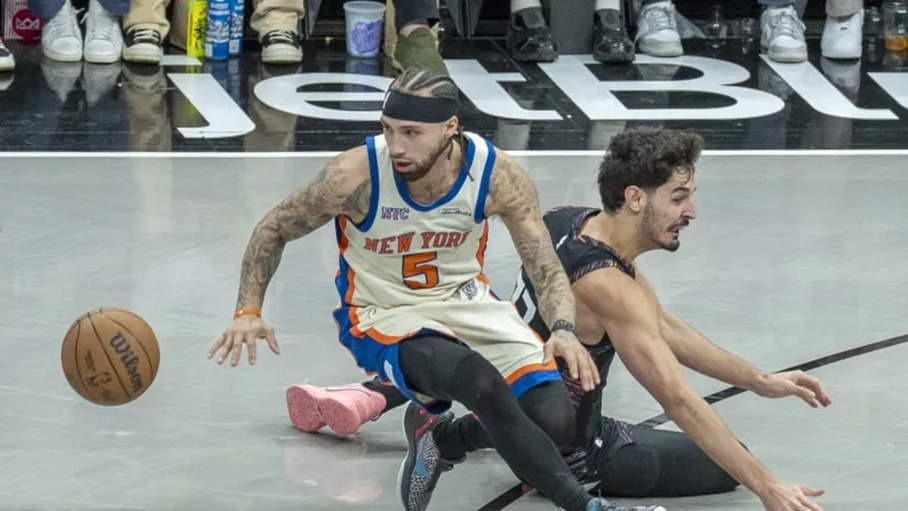
Two Careers Meet on the Same Court
Alvarado’s road was narrower and closer to the pavement. Born in Brooklyn to a Puerto Rican father and Mexican mother, he lived in Williamsburg and the Pomonok Houses in Queens. Basketball carried him to Christ the King, where he recorded the school’s first quadruple-double, then Georgia Tech, where he became the ACC Defensive Player of the Year and helped win the program’s first conference championship in 28 years.
Then every NBA team passed.
That omission became the organizing fact of his career. Alvarado entered the league on a two-way contract in New Orleans and built a reputation on possessions that polished players sometimes treat as disposable. He hid behind ball handlers, stole the ball from blind spots, and became “Grand Theft Alvarado.” New York acquired him in February for Dalen Terry, two second-round picks, and cash. The return to the hometown did not guarantee a role. It guaranteed scrutiny.
His defining Finals moment came with the Knicks 29 points behind in Game 4, facing what looked like a tied series. Alvarado played 16 minutes, scored eight points, and hit two three-pointers during the largest comeback in NBA Finals history. Eight points are modest on an ordinary night. Here, they were oxygen. New York won 107-106 and moved within one victory of the title.
The episode reveals the social architecture of championship teams. Towns represents elite investment: size, skill, pedigree, and a blockbuster trade. Alvarado represents contingent labor: the reserve is asked to stay ready without knowing whether his name will be called. Latin American audiences recognize both figures. One is the prodigy expected to carry family hopes. The other enters through the side door and refuses to leave.
Even Alvarado’s criticism of Wembanyama after the French star skipped the postgame handshakes fit that ethic. He admired the aggression inside the game but argued that competition should end with acknowledgment outside it. Coming from a defender whose profession is irritation, the distinction was revealing. Fight hard. Then look at the other person. In Caribbean sporting cultures, where games absorb questions of class, migration, and national worth, that boundary is a civic code.
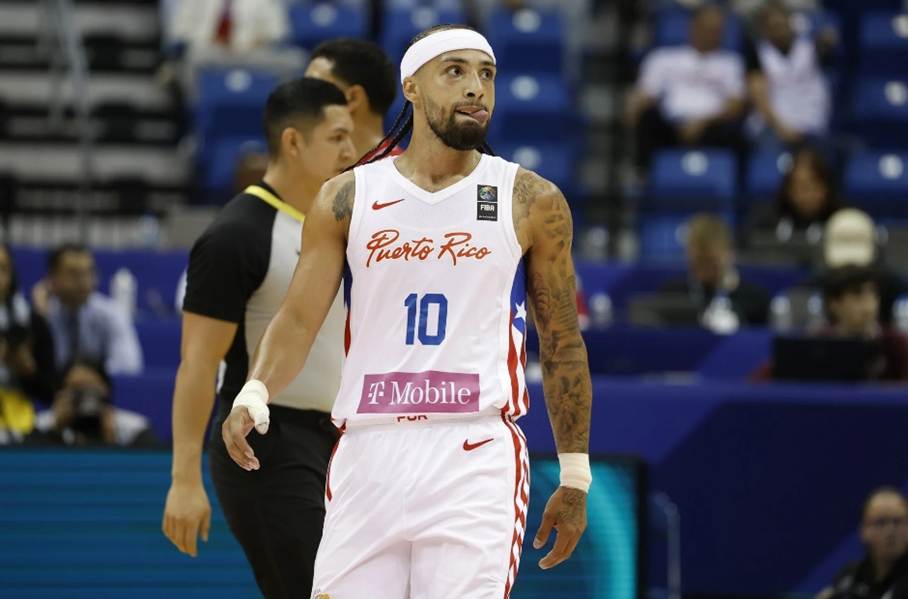
The Caribbean was not merely a decoration.
For Puerto Rico, Alvarado’s ring joined a small lineage. He became only the third Puerto Rican player to win an NBA championship, after Butch Lee in 1980 and J.J. Barea in 2011. More importantly, he had already made the island central to his career. At the 2024 Olympic qualifying tournament in San Juan, Alvarado averaged 16 points, 3.8 rebounds, three assists, and 2.3 steals, earned MVP honors, and helped Puerto Rico end a 20-year Olympic absence.
That achievement carried political weight. Puerto Rico is under U.S. sovereignty yet competes internationally with its own basketball team. Alvarado can be a Brooklyn New Yorker, the son of a Mexican mother, a Puerto Rican national-team guard, and an American citizen without any identity canceling another. The flag around his shoulders after Game 5 was not a costume. It declared that Puerto Rican nationhood travels, especially through a diaspora formed by citizenship, colonial history, and migration.
Towns’s Dominican meaning is different but related. The Dominican Republic’s global sporting mythology is often narrated through baseball. His career widens the country’s athletic imagination. A center that shoots like a guard, represents the national team, and invests in youth infrastructure offers Dominican children another language for ambition. Yet his example also exposes a regional weakness. Caribbean countries often celebrate diaspora athletes trained in U.S. schools, colleges, and professional systems while local facilities remain uneven.
That is what this Knicks title means for Latin America. Sporting nationality is increasingly built across borders. Diaspora players can strengthen national teams, attract sponsors, and give children recognizable heroes. They also reveal the asymmetry beneath the celebration: the United States supplies much of the development pipeline. At the same time, ancestral homelands receive the symbolic return. Towns’s planned facility and Alvarado’s national-team commitment suggest a better exchange, one that sends resources and labor back alongside emotion.
New York is the ideal stage. The city is not only an American metropolis. It is a Caribbean capital assembled through apartment kitchens, bodegas, churches, playgrounds, and remittances. The Knicks’ drought belonged to those neighborhoods, too. So did the release.
A championship cannot repair Puerto Rico’s political status, strengthen Dominican institutions, or erase the pressures separating Caribbean families. It can change the available picture. Towns did not have to be born in Santo Domingo to carry their mother’s country. Alvarado did not have to grow up in San Juan to make Puerto Rico visible. Their identities were not weakened by movement. They were made through it.
The final belonged to Brunson’s 45 points. The season belonged to an entire roster. But when Towns embraced his family, and Alvarado lifted gold beneath a Puerto Rican flag, the trophy entered another geography. New York had waited 53 years. The Caribbean had been there the whole time.
Also Read: Haiti Sees World Cup Jersey History and Memory Turned into Contraband Again