The fourth industrial revolution: Will robots steal our jobs?
According to the World Economic Forum, "machines will do more tasks that humans by 2025"

Over the years, new technologies have been developed and have taken control over various aspects of day-to-day life. However, along with the benefits that new advances have brought, uncertainty and even fear about the future of human labor has been generated. The dystopian image of robots displacing man from his work is still quite recurrent around the world.
Leer en español: Cuarta revolución industrial: ¿Los robots nos robarán los puestos de trabajo?
A survey conducted by Gallup suggested that 37% of millennials are afraid of losing their jobs in the next 20 years due to advances in artificial intelligence.
However, the latest report of the World Economic Forum, entitled The Future of Jobs, makes a detailed analysis of the current situation and estimates some results that raise a different perspective on the future of the works and the socio-economic and educational restructuring in the fourth industrial revolution.
Not all jobs are at risk
The report detected a series of trends in the occupations that have been growing and those that have decreased in the last five years. Around the world, works derived from technology, such as software engineering and Big Data analysis, as well as skills in the development of mobile applications, neural networks and artificial intelligence, have been increasing.
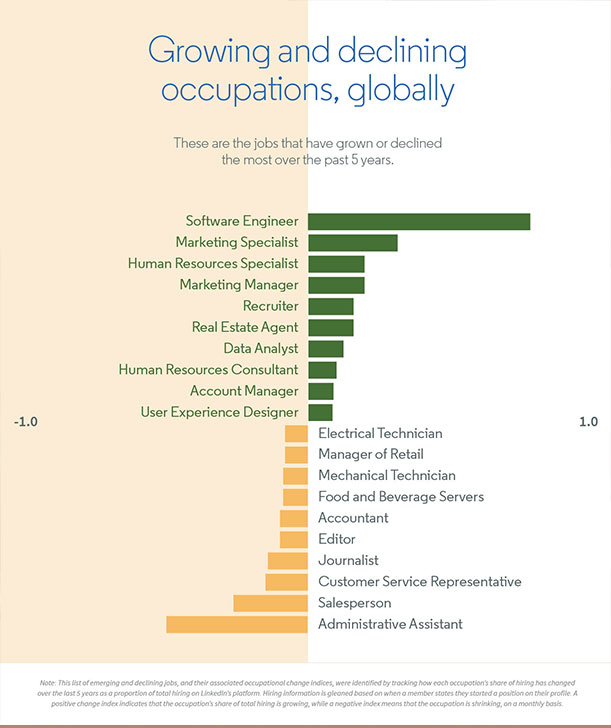
The report clarified that not only the works in this area have been increasing. Another trend indicates another line of occupations that are intrinsically dependent on human skills, which are called "human centric" jobs. As examples, here they included works such as customer service, digital marketing, human resources, among others.
Analyzing statistics in LinkedIn's millions of profiles, they also found that among the skills that have increased most in them are those that are related to artificial intelligence and automation. Between 2015 and 2017 there was an increase of 190%.
The importance of adapting the workforce
Now, what predictions do they make about the change in the workforce due to these factors and trends? In search of more efficiency and productivity, industries have been investing in emerging technologies to compete in the international market.
The World Economic Forum indicated that there is a positive correlation between the level of AI penetration in a region and the level of innovation. The countries that make the most use of this are the United States, China, India, Israel and Germany. However, this has led to profound changes.
You can also read: Higher education: "A waste of time and money"
It is estimated that by 2025, the work done by machines will go from 29% to 50%, although this change will be accompanied by the demand for a new labor market, thus opening a window of opportunity. Although it is not yet possible to know precisely what kind of jobs and roles are to be carried out, and what training will be necessary, we do know by which road they are going and what skills should be developed.
That is why it also calls on educational institutions, governments and companies to invest in programs related to technological development. This is because by 2020, no less than 54% of workers worldwide must increase their skills and knowledge in areas such as artificial intelligence.
More new jobs than vacancies
According to surveys conducted for the same report, by 2022, around 50% of companies expect automation to lead to a reduction in the complete times of their workforce. 38% of companies plan to extend their workforce to new, more productive roles and 15% expect to fill vacancies with automations.
Despite these responses there is a positive outlook. Thus, they believe that by the year 2022, the emerging professions will lead to an increase in employment from 15% to 27%, while the percentage of unemployment will go from 31% to 21%.
Studies conducted by The Center for European Economic Research (ZEW) found that companies that have invested in digitization have created a significant amount of jobs that other companies do not. Some of their estimates indicate that 75 million jobs will be displaced by the division of labor between humans and machines, while 133 million new roles more adapted to this new division will emerge.
It is undeniable that certain jobs will be lost because of the development of new technologies, but new jobs will be created that also lead to other socio-economic developments such as the rise of the middle class in emerging economies and demographic changes. However, it is important that the appropriate path be followed against this change, as educationally, so that the possibilities are positive and productive.
LatinAmerican Post | Valentina Moya
Translated from "Cuarta revolución industrial: ¿Los robots nos robarán los puestos de trabajo?"