Mexican Pop Prince Cristian Castro Summons Metal Gods and Memory
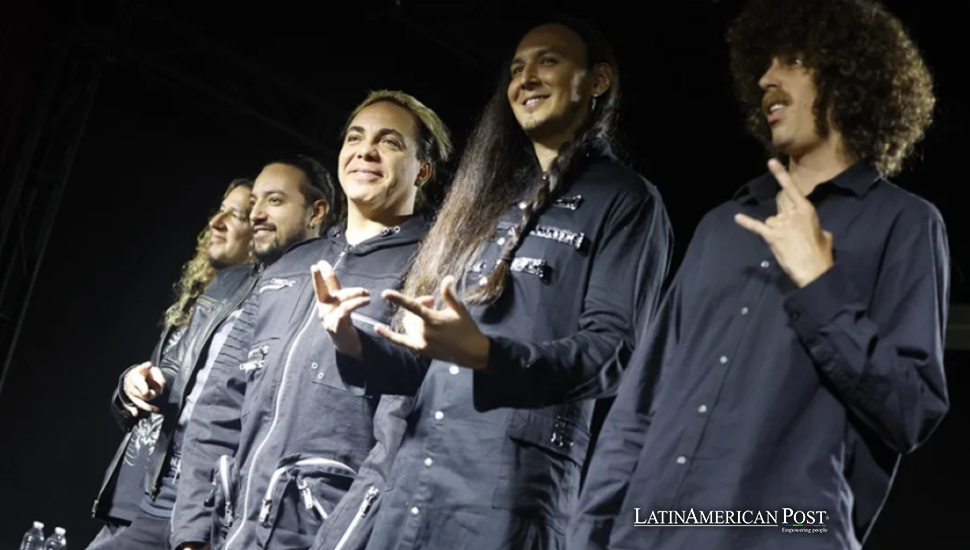
After three decades of romantic ballads, Cristian Castro is again becoming Lügh Draculea, his metal alter ego. La Esfinge’s third album blends Quetzalcóatl, gothic spectacle, and commercial ambition, revealing why Mexico’s pop prince never truly abandoned the music of adolescence.
The Balladeer Behind the Armor
For most listeners, Cristian Castro arrives through a polished chorus. His voice belongs to Latin pop’s grand tradition of longing made public, the romantic suffering that traveled from television sets to family stereos and across borders. Songs such as “Azul” fixed him in that world.
Then the armor appears.
For 12 years, Castro has periodically stepped onto another stage as Lügh Draculea, the alter ego he created for La Esfinge. The name is a theatrical escape hatch. It lets one of Mexican pop’s most recognizable singers replace clean balladry with progressive metal, gothic imagery, distortion, lasers, and ritual.
At a Mexico City news conference, Castro announced that La Esfinge’s third album will push that transformation further. The 12-song project, likely titled La serpiente emplumada, will draw upon Quetzalcóatl and a pre-Hispanic universe of pyramids, volcanoes, ceremony, and infinity.
“We want to make a ‘Sphinx’ like Quetzalcóatl, with its pyramids, its volcano, its infinities,” Castro said, according to EFE. He described the image as an amulet, something precious enough to carry the band into its next chapter.
Castro is not merely decorating metal with Mexican symbols. He is trying to solve an old problem for Latin American artists working inside imported genres: how to sound global without becoming culturally anonymous.

Quetzalcóatl Enters the Arena
Mexico has repeatedly absorbed outside musical forms and pulled them into local conversation. Rock, bolero, mariachi, pop, and telenovela melodrama rarely remain in separate rooms. Castro’s career proves that permeability. He moved from child television appearances and romantic stardom into mariachi, tributes to José José, live collaborations, and now darker mythology.
His metal turn looks eccentric only if his public image is mistaken for his entire biography. Castro told reporters that the dream began in secondary school. The songs on La Esfinge’s first album, El cantar de la muerte, were written during those years with his school band.
“It has always been my dream,” he said, according to EFE.
That confession changes the story. Lügh Draculea is not a costume invented after pop success. He is the adolescent musician who survived beneath it. The first album appeared in 2014, followed by La Cruel Cantora in 2023. The new record is a long-delayed attempt to give an old obsession a sustainable form.
Castro now speaks openly about balance. He wants the third album to sit between the darkness of the first two projects and a more romantic, accessible sound. Some songs, he said, will be “a little more commercial.”
For a singer with his history, commercial is not an insult. Latin pop taught him how melody travels and how emotional directness crosses class and national boundaries. The challenge is whether La Esfinge can use that knowledge without sanding away the danger that gives metal its force.
That tension is the album’s real subject for Castro now, even more than gods, costumes, volume, or theatrical excess.
The first test will be “Mensajero,” scheduled for release on September 17. As the advance single, it must show whether Castro’s proposed middle ground sounds like fusion or compromise.
The stage production suggests spectacle, not retreat. Castro told EFE that two facing sphinxes, lasers, Mexican landscapes, ancestral imagery, and an Aztec ceremony will frame the concerts. In a weak production, those elements could become souvenir history. In the right one, they could make the arena a debate about who represents Mexico and how ancient symbols survive inside mass culture.

A Mexican Export Still in the Making
Castro wants La Esfinge to represent Mexico abroad. That ambition asks audiences to accept that the singer associated with romantic pop can also stand for Mexican metal without treating either identity as parody.
The band, formed with David Avilés, Alejandro Carrera, Alexei Torres, and Bryce Snowden, will begin its tour December 4 and 5 at Mexico City’s Palacio de los Deportes. It continues December 11 and 12 in Monterrey and reaches Guadalajara on January 15 and 16.
Castro will also share the stage with Alex Lora, the veteran leader of El Tri. That pairing offers a kind of Mexican rock legitimacy that makeup cannot manufacture. His recent collaboration “Se fue el sol” with Argentine musician Gustavo Santaolalla adds another bridge between Castro’s established voice and Latin rock.
Still, the strongest argument for La Esfinge may be Castro himself. Born into one of Mexico’s most visible entertainment families, he grew up in television’s glare and became an international romantic idol at a young age. Every experiment would inevitably be measured against the songs people use to remember him.
That is why Lügh Draculea feels unexpectedly human. Beneath the gothic name is a middle-aged artist returning to something he loved before the market decided what he was best at. Many musicians spend careers protecting a successful image. Castro keeps opening his and letting the stranger inside walk out.
When the lasers rise around Quetzalcóatl, the spectacle may look extravagant. Its emotional core is simpler. A Mexican pop star is still trying to play the music he imagined in school, only now the room is larger, the mythology older, and the consequences more public.
Also Read: Colombian Star Karol G Makes Feeling a Global Power Move