Argentina’s Ni Una Menos Roars as Milei’s Cuts Meet Fury
Argentina’s Ni Una Menos anniversary became a national reckoning as women filled streets from Buenos Aires to Córdoba, denouncing femicide, austerity, and a state retreat that activists say leaves girls poorer, less protected, and frighteningly alone in public life today.
A March Heavy With Names
The rain in Córdoba did not soften the anger. It gave it a darker shine. On Wednesday, thousands of women across Argentina returned to the streets for the 11th anniversary of Ni Una Menos, the feminist cry born in 2015 from a country exhausted by murdered women and official excuses.
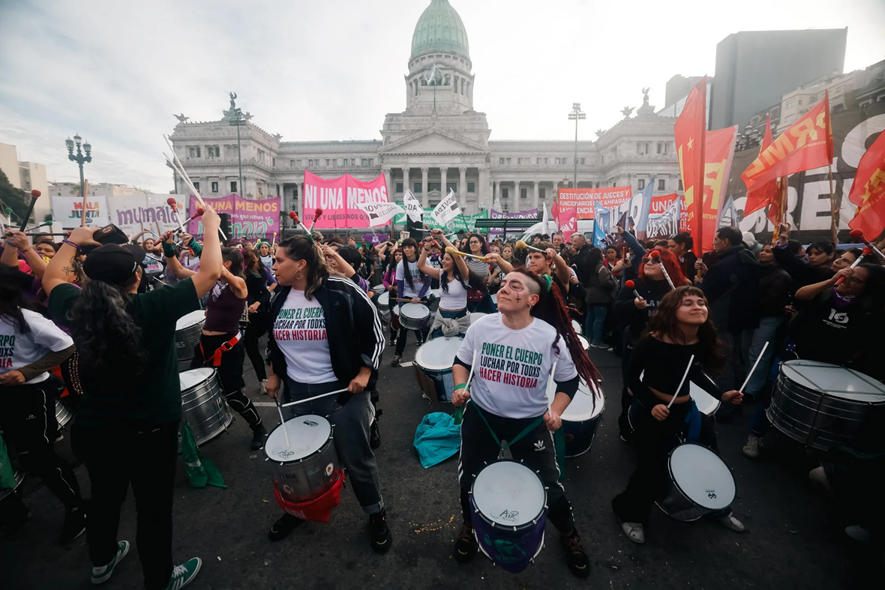
In Buenos Aires, they gathered near Congress with banners, flags, drums, hoarse voices, and the particular patience of people who have repeated the same warning for more than a decade. In San Miguel de Tucumán, Rosario, Córdoba, and Mar del Plata, the scene widened into a national map of grief. Grandmothers walked beside students. Union members stood beside feminist collectives. Opposition parties joined, but the mood was not simply partisan. It was intimate, raw, and increasingly directed at power.
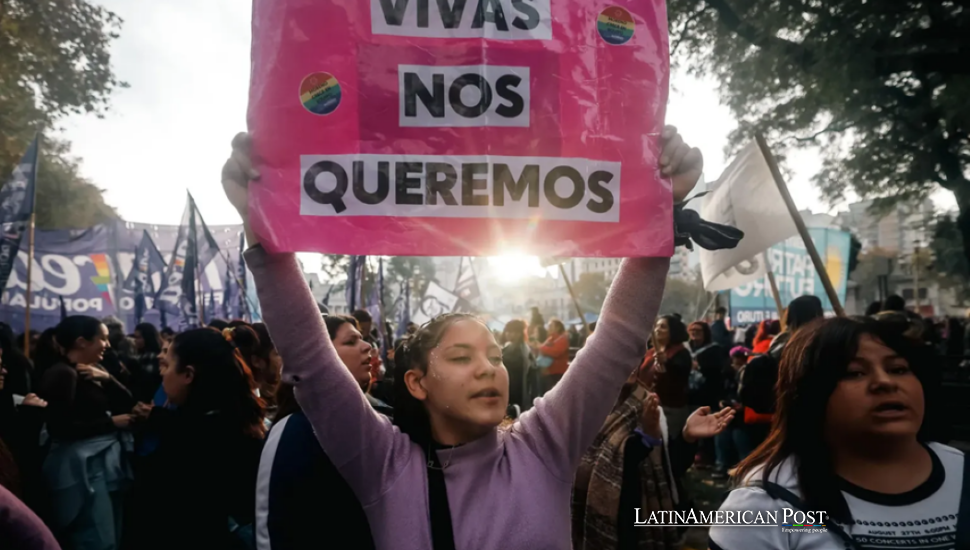
One sign in the crowd said a man kills a girl every 31 hours. Another demand moved through the march like a pulse: “Vivas, libres y desendeudadas nos queremos,” meaning women want themselves alive, free, and out of debt.
The phrase matters. It links femicide to money, survival, and public policy. It says violence is not only the final blow, the knife, the hand, the disappearance. It is also the unpaid rent, the closed office, the vanished hotline, the weakened shelter, the police report that goes nowhere.
Economist and feminist leader Luci Cavallero told EFE in Buenos Aires that Argentina’s national government is “rolling back many of the achievements made by the feminist movement in recent years.” Her words landed in a country where President Javier Milei’s administration has made austerity not only an economic program but a governing identity.
Austerity Enters the Home
Since Milei took office in December 2023, feminist organizations say federal budgets for preventing and eradicating gender-based violence have been slashed. They also say key departments that designed and carried out public policy have been dismantled or closed.
That is the central political charge of this year’s Ni Una Menos mobilization: not merely that violence continues, but that the state is retreating from the places where danger is most predictable.
The government points to official data showing a decline in femicides. Argentina’s National Registry of Femicides recorded 200 victims in 2025, compared with 228 the previous year, a decrease of 12.3 percent. But the argument over the numbers is itself revealing. Feminist organizations dispute the official count, saying judicial statistics miss cases and that at least 71 more victims should be included.
The gap is not just statistical. It is ideological. For Milei’s supporters, cutting gender programs can be framed as eliminating bureaucracy, ideology, and what they see as state overreach. For the women marching, those cuts are not abstract. They are measured in delayed searches, unanswered calls, and the long hours between disappearance and discovery.
The death of 14-year-old Agostina Vega turned that fear into a name.
Vega was killed in Córdoba province. Her dismembered body was found Saturday in a vacant lot, after days of anguish and protests over how authorities handled the search. Claudio Barrelier, 33, the only suspect charged in the crime, was arrested after security footage reportedly showed the teenager entering his home but never leaving.
Her grandmother, Elizabeth Fernández, told local media, as reported by EFE, that the family suffered through police inaction after reporting the girl missing. “It was and continues to be torture because they killed my granddaughter, and they continue to kill her,” she said through tears.
The sentence is devastating because it refuses closure. It accuses the crime, then the system around the crime. Vega’s family even delayed the funeral to march in Córdoba. In the rain, a banner reading “Justice for Agostina” led the procession, along with demands that Governor Martín Llaryora improve the provincial justice system.
Cavallero told EFE that Vega’s murder reflected “state-organized neglect” that “permanently jeopardizes the lives of young women.” It is a hard phrase, but it captures what many in the streets believe: that abandonment can be organized, budgeted, justified, and normalized.
Latin America Watches Closely
Argentina is not just another country in Latin America’s gender politics. It has often been a laboratory. Ni Una Menos helped reshape regional feminism, influencing movements from Mexico to Chile and Peru. The green scarf campaign for abortion rights turned Buenos Aires into a continental symbol of feminist persistence. When Argentina advances, the region listens. When it retreats, the region also hears the signal.
That is why this confrontation has geopolitical weight. Milei is not merely governing Argentina. He is exporting a style of right-wing libertarian politics that treats gender policy as cultural warfare and social spending as fiscal contamination. In a region battered by debt, insecurity, weak courts, and inequality, that model has admirers. It also has consequences.
Latin America’s femicide crisis thrives where institutions are thin, and impunity is thick. Courts move slowly. Police often dismiss families. Informal labor leaves women economically trapped. Organized crime and domestic violence feed one another in territories where the state appears mostly after death. Against that backdrop, dismantling prevention programs is not a neutral budget choice. It shifts risk downward, onto families, neighborhoods, mothers, friends, and girls.
The slogan about debt is especially Argentine, but it is also Latin American. Austerity has long arrived in the region, wearing technocratic language, then settling in kitchens. When inflation, job loss, and cuts to public services collide, women absorb the shock first. They care for children, elders, the sick, and the frightened. They also become more dependent on unsafe households and less able to leave violent men.
Oriana Ruiz, a 28-year-old literature student at the Buenos Aires protest, told EFE she worries about how Milei’s government speaks about gender violence. She said Argentina has a president who suggested the word “femicide” should be changed and claimed such crimes have declined.
Language is not a side issue. In Latin American politics, naming has always been power. Disappeared. Dictatorship. Debt. Femicide. Each word forces the public to see a structure that officials may prefer to an isolated tragedy. To rename femicide as ordinary homicide would flatten the social pattern that Ni Una Menos was built to expose.
Ruiz also looked toward another stage: the coming World Cup. Her plea was simple and politically sharp. Do not let the spectacle bury the women. Let men keep talking about their behavior.
That may be the deepest test for Argentina now. Not whether the marches remain large, they do. Not whether the slogans remain potent, they are. The test is whether a country famous for public argument can turn mourning into protection, data into policy, and outrage into a state that arrives before the funeral.
Also Read: Nicaragua Mothers Keep Score as Ortega’s Silence Outlives the Mother’s Day Massacre