Colombia Watches Disarmed Fighters Test a Hardline President’s Peace Promise

In Colombia’s southern jungle, 99 former guerrillas have surrendered weapons, planted medicinal gardens and called home. Now they face a harder uncertainty: whether President-elect Abelardo de la Espriella will honor a peace process he promised to dismantle once in office.
A Mother Who Thought Her Son Was Dead
Wilson Uraparí spent six years without speaking to his mother. He had entered Comandos de la Frontera at 19 and disappeared into the camps and combat zones of southern Colombia.
His mother eventually believed he was dead.
Only after arriving at a Temporary Location Zone, known by its Spanish initials ZUT, did Uraparí search social media for a relative. To prove he was really alive, he sent a photograph of an old identity document. The family connection reopened. Now the telephone rings every day.
“Now I call her every day, or she calls me,” the 25-year-old told EFE.
That domestic ritual may be the clearest measure of disarmament. Peace negotiations are usually described through decrees, negotiating tables and acronyms. For Uraparí, peace is his mother answering the phone. It is also possible to study nursing.
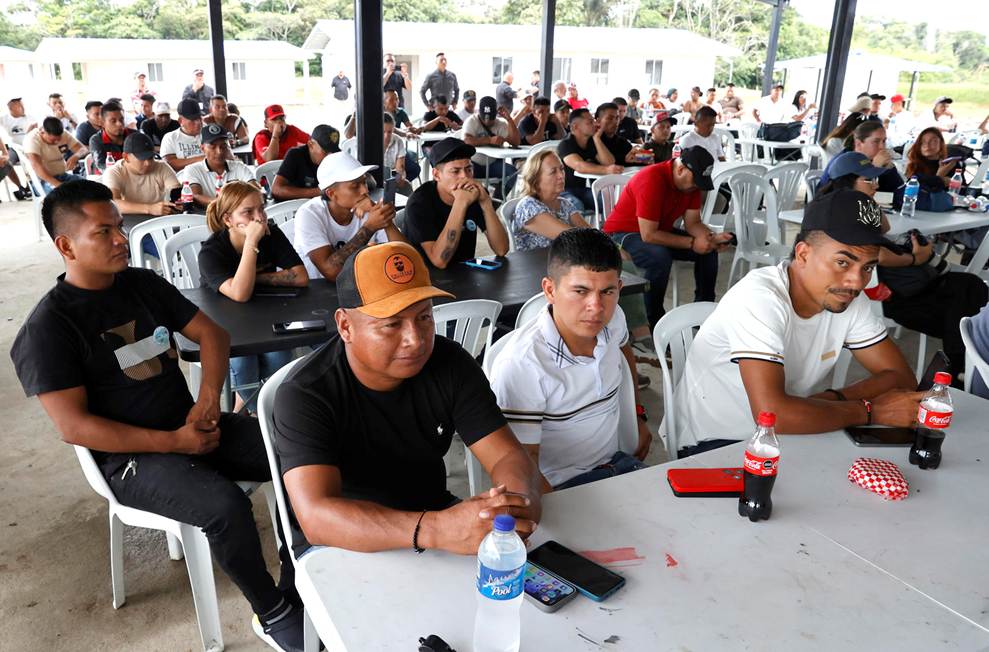
He is one of 86 men and 13 women who laid down their weapons on June 18 and entered the ZUT in Valle del Guamuez, in the jungle department of Putumayo. Comandos de la Frontera belonged to the Coordinadora Nacional Ejército Bolivariano, a dissident structure descended from the former FARC and active along Colombia’s border with Ecuador.
Inside the zone, camps and combat have been replaced by workshops, soccer games, murals, gardens and beds of medicinal plants. Men and women once organized around rifles now organize their days around civilian routines.
“The truth is, we want total peace, not only here, but throughout Putumayo,” Uraparí told EFE.
In Putumayo, armed authority has long occupied spaces left thin by the state. Roads, jobs, health care and security have never arrived evenly. Any peace policy that asks people to abandon weapons without building a viable civilian future demands faith from those with little reason to trust institutions.
Peace Meets the Transfer of Power
That trust now faces its first major test.
De la Espriella, who won the June 21 election and takes office Friday, has promised to end outgoing President Gustavo Petro’s “total peace” program. His hardline message against armed groups and crime produced fear inside the ZUT, where the former fighters have been disarmed for only six weeks.
Adrián Zambrano said none of them wants to reverse course.
“Keep betting on peace, because war brings nothing good,” he told EFE, appealing to the incoming president. “Do not leave us alone. The 99 of us here want to keep betting on peace and not take up arms again.”
Then he invited De la Espriella to Valle del Guamuez: come inside, see what is happening, and do not rely on what people outside say.
The request exposes the distance between campaign language and its human consequences. “Toughness” sounds clean at a podium. In a demobilization zone, it can mean the collapse of protection, legal commitments and personal plans. It can turn a would-be nursing student back into a military target.
The ZUT was one of the clearest achievements of talks begun in 2024 between Petro’s government and Comandos de la Frontera. It brought together the 99 members who had relinquished their weapons as negotiations advanced. Its importance is both practical and symbolic.
Armando Novoa, the government delegation’s chief negotiator, told EFE that dismantling the zone would amount to “institutional suicide.” If the state abandons commitments whenever an administration changes, future armed actors will conclude that negotiations are agreements with temporary politicians, not with Colombia.
“Halfway through, the state cannot change that road map and invite them to return to violence and take up arms,” Novoa said.
The State’s Word Is Also on Trial
Colombia has spent decades learning that laying down a weapon is not the same as securing peace. Reintegration depends on safety, income, education and credible institutions. A commitment becomes fragile when former combatants suspect that a new president can erase it before their civilian lives have begun.
Continuing the process would not require De la Espriella to endorse every part of Petro’s security strategy. A government can revise negotiations, demand verification and enforce conditions. What it cannot do without cost is treat disarmed people as disposable evidence of a predecessor’s failed policy.
There is a deeper distinction between firmness and rupture. Firmness means holding former fighters to their promises while holding the state to its own. Rupture means proving that only one side was expected to keep its word.
The 99 people in Valle del Guamuez are a small number in a conflict measured across generations. Yet their fate will be watched far beyond Putumayo. Other armed groups will study whether surrender produced protection or vulnerability. Rural communities will judge whether the government prefers negotiations that reduce violence or renewed confrontation. Families will learn whether recovered sons can remain recovered.
Uraparí imagines a university classroom and a nursing career. Zambrano wants to open a business after completing his transition through the ZUT. Neither speaks as though the past has vanished. They speak as people trying to keep it from reclaiming them.
A rifle can be surrendered in a morning. Trust takes longer. In Putumayo, it is being built through phone calls, painted walls, medicinal seedlings and plans fragile enough to be destroyed by a signature. The 99 former fighters say they will not return to war. Colombia must now decide whether the state intends to meet them outside it.
Also Read: Peru Continues Watch as Machu Picchu Fire Tests Andes Tourism’s Defenses