Bolivia’s Mosaic Women Turn Broken Tiles Into Lasting Public Power
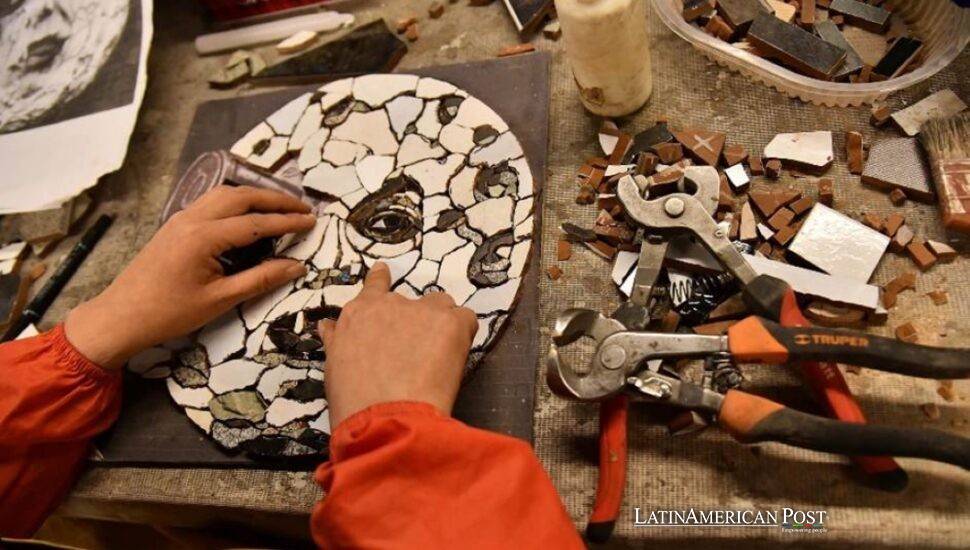
In Cochabamba, discarded ceramics become mosaics, murals, and income through Kuska, a women’s collective that has spent thirteen years turning urban waste into public memory, economic opportunity, and a shared claim to Bolivia’s streets, galleries, cultural imagination, and collective future.
Where Waste Finds a Second Life
On a workshop table in Cochabamba, a broken tile stops looking broken.
Nippers bite into its glazed edge. The fragment becomes a curve, perhaps a petal or a cheekbone in the portrait of a woman who will later appear on a wall. Nearby are pieces from streets, construction sites and shops. What the city rejected returns, rearranged.
That reversal is the working language of Kuska, a women’s mosaic collective born thirteen years ago inside the Creative Communities Laboratory of Proyecto mARTadero, an arts center in Villa Coronilla. The group began as a place where neighborhood women could learn mosaics, but its purpose was never limited to technique.
“The idea was to create a space for the women of Villa Coronilla,” coordinator María René Camacho told EFE. The aim, she said, was also to help them earn money and recover from blows to their self-esteem.
In Quechua, kuska means together. The collective started with about fifteen members, from schoolgirls to grandmothers. Their lives differed, yet Camacho said they found it easy to agree on the interventions they wanted to make.
Membership changed. During the past five years, the group has remained steady at seven or eight women. Community arts projects often rise with a grant, then disappear when money thins. Kuska has lasted long enough to build a method, identity and body of work.
“Together we have tried to overcome many problems,” Camacho told EFE. “Together we became known. Together we went to teach classes inside the country and abroad.”
A Workshop Built on Second Chances
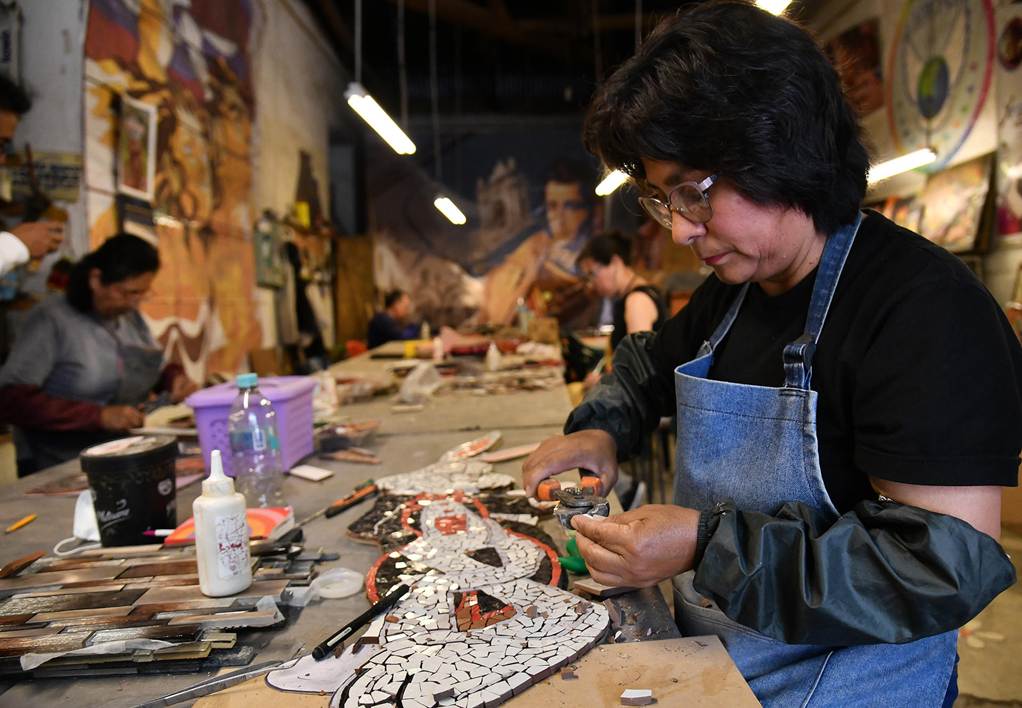
Most of Kuska’s raw material has failed in the market. Tiles crack, ceramics are discarded, construction debris piles up. The Kuskas collect what they can and sometimes buy broken pieces from stores. They cut the fragments into tesserae, shaping lines or curves for a planned image.
Every shard must be judged for color, thickness, angle, and possible use. A piece too small for one design may become essential in another. Mosaic resists the fantasy of perfection. Its beauty depends on visible separations, on grout lines admitting that each part was once apart.
Camacho sees an echo between the material and the women entering the room.
“We believe that here in the workshop, some of the women come to give themselves a second chance,” she told EFE.
It is a strong metaphor, but Kuska’s work is more concrete than metaphor. The women make pieces for exhibitions and sell ornamental objects through a shop at mARTadero. Public commissions also generate revenue. The money supports the collective and allows members to earn their own income.
That economic dimension is crucial. Across Latin America, women’s craft is often praised as heritage while remaining poorly paid and treated as domestic labor. Kuska pushes against that contradiction by making skill visible and attaching payment to it. A mural is not merely decoration. It is commissioned labor, design, material knowledge, and authorship.
The collective cannot repair structural inequality. Seven or eight artists securing occasional commissions are not a substitute for stable employment or social protection. Kuska demonstrates something smaller, but specific: technique, shared production and a recognized name can turn discarded material into income without erasing the women behind the work.
The group also practices a quiet circular economy, extending the life of material that would otherwise become rubble. Its volume is small, but its cultural argument is sharp. Waste returns to the center as an image people must see.
Feminizing Bolivia’s Urban Memory
Kuska’s identity crystallized in 2014 with a mural at Cochabamba’s Adela Zamudio Theater. Zamudio, the Bolivian poet and educator regarded as an early feminist figure, became more than the subject of the group’s debut. She became a declaration of direction.
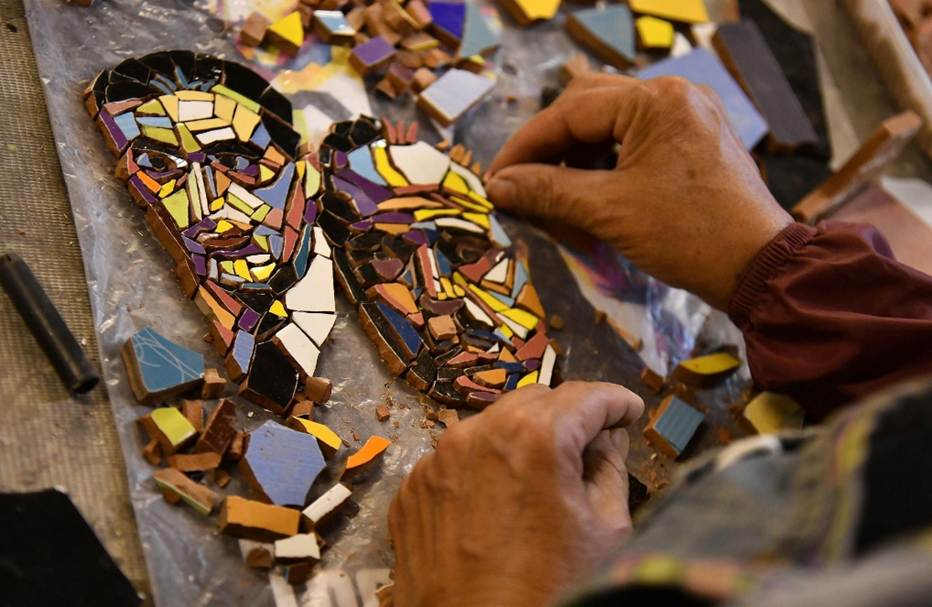
The mural shows a woman’s face, with a Cochabamba landscape emerging from her hair. It includes a fragment from Zamudio’s poem “Nubes y vientos” and an image of the poet herself. The composition binds body, territory, and language. The city does not sit behind the woman. It grows from her.
Camacho said the collective understood then that it wanted to make art centered on women and to “feminize the city.” She told EFE that women could send society messages about healthy life and family. The phrase sounds gentle, but the intervention is political: it concerns who appears in the city, whose face becomes monumental and whose labor marks a wall.
Bolivian cities, like many across the region, have historically commemorated presidents, soldiers, priests, and male intellectuals more often than women. Kuska changes that balance piece by piece. Its murals do not wait for women to be admitted into official bronze. They build another archive from ceramic fragments.
The collective moved into streets and plazas across Cochabamba, then traveled to Sucre and Tarija. In Arica, Chile, the women taught a workshop and created a mural with local participants. The method crossed borders without losing its communal logic.
Their most recognized intervention came in Cochabamba’s San Rafael passage, where Kuska created thirty-six portraits of notable Latin American women. The work earned the Eduardo Abaroa Prize for contemporary arts in 2017.
Thirty-six faces in one passage do more than honor individual biographies. Together, they alter the experience of moving through the city. A pedestrian encounters female history not as a book chapter, but at eye level, embedded in daily life. The passage becomes a corridor of recognition.
Kuska’s deepest achievement may lie there. It takes what has been cast aside, whether ceramic, neighborhood space, or women’s authorship, and refuses to leave it invisible. The result is neither charity nor ornament alone. It claims that damaged things can carry beauty, public memory can be rebuilt, and Bolivia’s walls can speak in women’s names.
Also Read: Ecuadorean Film Tests Family Loyalty Against Quito’s Violent Criminal Underworld