Colombian Shakira Turns World Cup Opener into a Latin Soundtrack
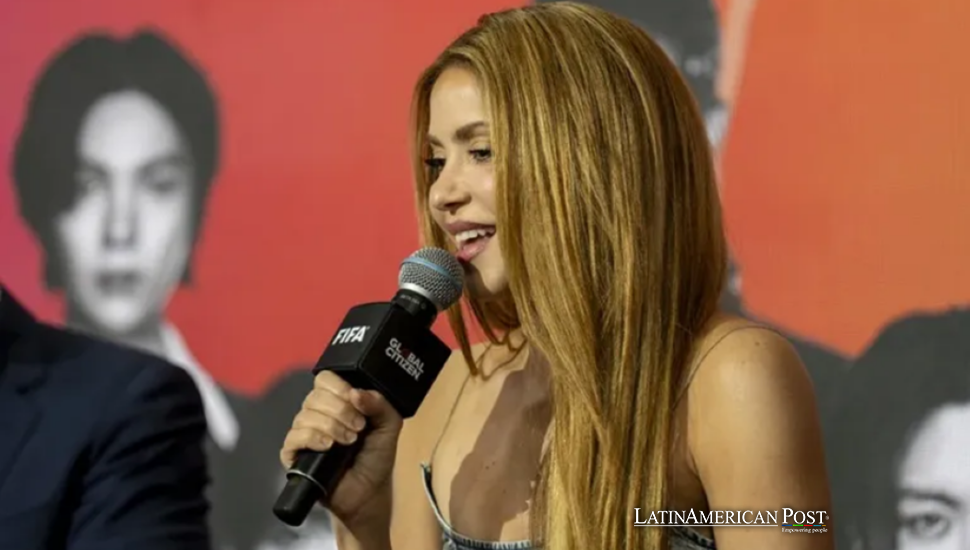
Shakira and Burna Boy will premiere “Dai Dai” at Mexico’s World Cup opener, turning a FIFA ceremony into a test of Latin America’s cultural power, commercial ambition, and uneasy place inside a tournament shared with the United States and Canada.
The Anthem Before the Whistle
Before Mexico and South Africa touch the ball at Estadio Azteca on June 11, the first roar of the 2026 World Cup will belong to a Colombian woman and a Nigerian man. Shakira and Burna Boy are set to perform “Dai Dai,” the official song of the tournament, in an opening ceremony that FIFA has loaded with the kind of names built to travel: Alejandro Fernández, Belinda, Danny Ocean, J Balvin, Lila Downs, Los Ángeles Azules, Maná, and Tyla among them.
It sounds, at first, like a spectacle. Sequins, cameras, choreography, the Azteca vibrating before kickoff. But World Cup music is never only music. It is branding with a chorus. It is diplomacy with bass. It is a host country trying to tell the world who it is, and a federation trying to tell the world what kind of tournament it has sold.
For Shakira, this is familiar terrain. She has already become part of soccer’s global memory through “Hips Don’t Lie” in 2006, “Waka Waka” in 2010, and “La La La” in 2014. FIFA now returns to her not because nostalgia is cute, but because nostalgia performs. It moves across generations. It gives the tournament an emotional shortcut, especially in Latin America, where soccer and pop have long shared the same crowded living room.
The Colombian singer’s presence also matters because 2026 is not just another World Cup. It is the first expanded 48-team tournament, spread across Mexico, the United States, and Canada, with 104 matches and a final scheduled for July 19 at MetLife Stadium in New Jersey. (People.com) The geography alone tells a story of power. North America gets the logistics, the stadiums, and the money. Mexico gets memory.
Mexico Gets the Soul
The Azteca is not a neutral stage. It is a cathedral of Latin American soccer, heavy with Pelé in 1970, Maradona in 1986, and a thousand family stories told from couches in Guadalajara, Barranquilla, Lima, and San Pedro Sula. FIFA has said the stadium will become the first to host three World Cup opening matches, a detail that turns concrete and grass into historical capital.
That is why Shakira’s choice lands differently in the region. She is not simply a global pop act. She is Barranquilla-exported, Caribbean hips translated into corporate English, a Latin American artist who learned to speak MTV, Spotify, Super Bowl, and still sounds like a neighborhood party when she needs to. Her career has often mirrored the region’s own cultural bargain: enter the global market, but do not arrive empty-handed.
Burna Boy’s role sharpens the message. His Afrobeats presence connects Latin America to Africa through rhythm, diaspora, and colonial history, not through the flat, diversity-as-language that corporations prefer. “Dai Dai” becomes a small map of the Atlantic world, where drums, ports, migration, and memory keep meeting. In a tournament shared with the United States and Canada, that matters. Latin America is not merely the colorful opening act before the richer markets take over. It is a source code.
The lineup around them deepens that claim. Lila Downs brings Indigenous and Mexican regional memory. Los Ángeles Azules carry cumbia’s working-class Mexico City afterlife. J Balvin represents the commercial triumph of reggaeton and Colombia’s urban export economy. Maná carries the old continental passport for rock en español. Alejandro Fernández brings ranchera lineage. Belinda and Danny Ocean point to pop’s transnational sprawl. This is not one Latin America. It is several, sometimes harmonious, sometimes competing, all trying to be heard before the match begins.
Soft Power with a Price Tag
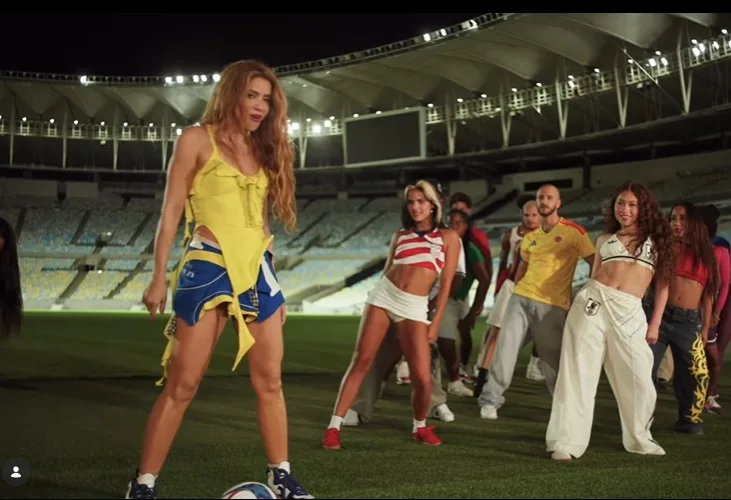
FIFA says “Dai Dai” will support the FIFA Global Citizen Education Fund, an initiative seeking to raise $100 million by the end of the tournament to expand access to soccer and quality education for children worldwide. (Inside FIFA) That philanthropic frame is important, but it also deserves scrutiny.
Latin America knows the grammar of grand promises. Mega-events often speak of children, opportunity, and urban renewal. They leave behind improved airports, yes, but also debt, displacement, policing, informal vendors pushed aside, and stadium neighborhoods made temporarily presentable for television. Mexico, Brazil, and other regional hosts have lived this before. The cultural glow is real. So is the bill.
The deeper question is who benefits when Latin American culture becomes the emotional engine of a global sports product. Shakira’s voice will help sell the tournament to billions. Mexican history will sanctify it. Colombian and Caribbean rhythms will make it feel intimate. Yet the largest commercial infrastructure sits heavily to the north, in U.S. media markets, corporate suites, and sponsor ecosystems.
That tension is the Latin American story inside 2026. The region is indispensable to the World Cup’s myth, but not always central to its profits. It supplies songs, icons, labor, fans, migrants, memories, and players. It supplies the atmosphere that money cannot manufacture from scratch. Then it watches as the machinery of global sports turns atmosphere into an asset.
Still, there is power in being impossible to ignore. When Shakira steps onto the Azteca stage, she will carry more than a hook. She will carry the long Latin American talent for making joy under pressure, for converting scarcity into rhythm, for turning public space into a chorus even when politics disappoints. That is not a cliché. It is a survival technology.
FIFA’s new immersive pre-match ceremonies, with giant flags and field-level elements meant to pull fans and players into a shared scene, suggest the federation understands something the region has always known: soccer begins before the whistle. It begins in the walk, the chant, the grandmother ironing the jersey, the vendor outside the stadium, the kid who cannot afford a ticket but still knows every lyric.
“Dai Dai” will premiere as entertainment. It will also serve as a reminder. Latin America may not control the tournament’s balance sheet, but it still knows how to control the room.
Also Read: Puerto Rican Bad Bunny Turns Madrid Into a Caribbean Powerhouse