Mexico’s Cenote Angelita Hides a Ghost Cloud Beneath Sacred Waters
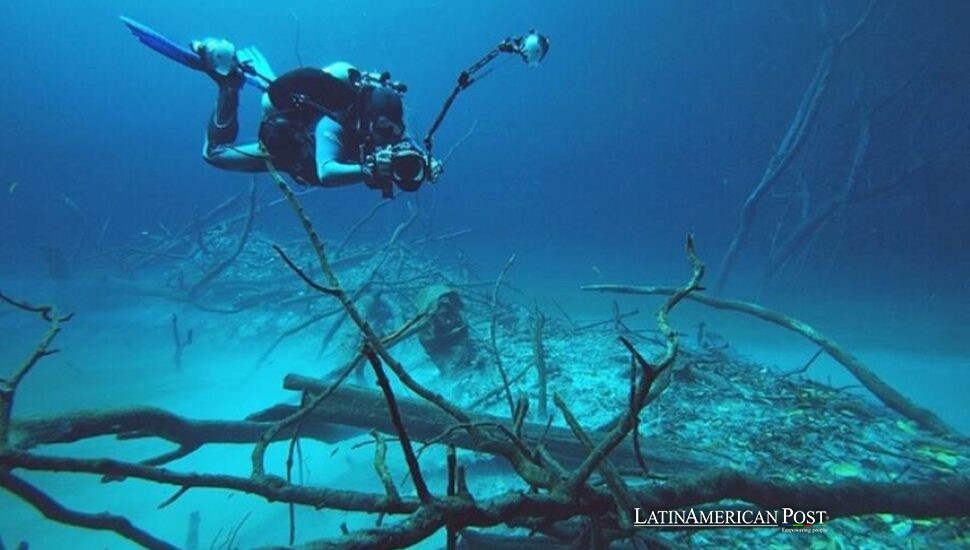
Beneath Mexico’s Yucatán Peninsula, Cenote Angelita turns geology into theater: a clear sinkhole, a false underwater cloud, submerged trees, and a strange reminder that the region’s beauty is also a record of impact, time, water, and memory.
A Sinkhole That Feels Like a Warning
Cenote Angelita looks, at first, like one more miracle in a peninsula full of them. Mexico’s Yucatán Peninsula holds around 7,000 cenotes, natural limestone sinkholes scattered mainly through Quintana Roo, Yucatán, and Campeche. They are famous for their clear water, their sudden openings in the earth, their impossible blue, and the sense that the ground itself has learned how to breathe.
But Angelita is different. Its name translates as “Little Angel,” a gentle name for a place that feels almost ghostly once the descent begins. About 17 kilometers south of Tulum, the cenote drops about 60 meters. Divers enter through the first 10 meters of murky water, then break into clear water. Below them, something appears that should not be there: a giant cloud resting underwater.
It is not a cloud, of course. It is not a lake either, though many describe it as a “lake within a lake.” Freshwater flows into the sinkhole and rests on underground saltwater. Where the two meet, a layer of sulfate gathers and swirls, forming what can look like mist, river, lake, or cloud. In Angelita, the depth, clarity, and structure allow a roughly 3-meter-thick layer of hydrogen sulfide gas to remain visible and consistent, turning chemistry into spectacle.
That is the trick of the cenote. It does not invent magic. It reveals the strange machinery of the real.
In a tourism economy built on beauty, Angelita offers something more unsettling than a postcard. It asks the visitor to look down and remember that the Yucatán is not only beaches, resorts, and bright water. It is limestone, collapse, impact, filtration, underground rivers, and ancient cavities filled with time.

The Peninsula Remembers Impact
The notes describe cenotes as having formed around 66 million years ago due to the Chicxulub meteorite impact, which triggered the collapse of limestone bedrock. The cavities were created and then filled with water. That origin gives every cenote a double life. It is both landscape and wound, both swimming hole and geological archive.
The limestone acts as a purifier, removing impurities from the water. That is why cenote water can appear so crystalline, almost unreal. Yet the clarity can mislead. Clear water is not empty water. It is water that has passed through stone, water shaped by pressure, chemistry, and buried structure. In Cenote Angelita, that clarity makes the false cloud even more dramatic. The eye can see too much, and suddenly the bottom becomes a stage.
This matters in Mexico because landscapes here are rarely just landscapes. They carry stories that official language often flattens. The Yucatán Peninsula is presented to outsiders as paradise, and it is beautiful, yes. But its beauty is built from rupture. Angelita’s underwater cloud is haunting because it makes that rupture visible without saying a word. The diver sees a world divided into layers: surface, murk, clarity, cloud, and darkness.
That layered vision feels almost political in a country where land and water have long been sites of memory, extraction, development, and reverence. The cenote does not argue. It simply shows that what appears calm on the surface can conceal another world below.
The submerged trees deepen that feeling. Within the giant underwater cloud lies a submerged forest, made of decaying trees and foliage that have fallen into the cenote over thousands of years. The image is unforgettable: trunks and branches held in chemical mist, no longer fully part of the living forest above, not yet dissolved into the depths below.
It is easy to see why divers find it eerie. Angelita does not offer the usual drama of reefs and color. It offers stillness. A forest under a cloud under the earth. A vertical cemetery of wood and water. A place where decay becomes scenery, and time becomes visible in the shape of fallen trees.

Beauty Lives Beside Emptiness
Cenote Angelita’s lower reaches, like those of many cenotes, are dark and nutrient-poor. They are mostly devoid of life. Closer to the surface, where sunlight still penetrates, freshwater fish and aquatic plants are more likely to appear. There, plants can photosynthesize. Below, the world thins out.
That contrast is part of the cenote’s power. Near the surface, life. Deeper down, silence. Between them, a cloud that looks supernatural but comes from the meeting of waters. Angelita’s beauty depends on separation: freshwater and saltwater, light and darkness, surface life and deep emptiness, living forest above and drowned remains below.
For Mexico, Angelita is more than a dive site. It is a lesson in how fragile wonder can be. Cenotes depend on the systems that feed them: limestone, underground water, filtration, rainfall, and the surrounding land. Their clarity is not guaranteed by beauty. Conditions produce it. Change those conditions, and the miracle changes too.
The notes do not need to spell out a conservation warning for one to appear. When a place becomes famous for its clear water, its delicate layers, and divers seeing a cloud under the surface, then the very attraction depends on restraint. Too much carelessness, too much pressure, too much assumption that the landscape exists only for consumption, and the spell can break.
Angelita’s strange cloud is therefore not only a marvel. It is a border. It marks where different waters meet, but also where different ways of seeing Mexico meet. One sees an adventure destination. Another sees a geological memory. Another sees an underground forest. Another sees the long patience of limestone, turning catastrophe into clarity.
That is why Cenote Angelita lingers. Not because it is the deepest or the loudest or the most decorated by life. It lingers because it appears impossible, then explains itself through the earth’s own logic. It is haunted without needing a ghost. It is beautiful without being comforting.
At the bottom of this 60-meter sinkhole, the cloud waits. Above it, divers float in clear water. Within it, old trees decay. Around it, Mexico’s Yucatán Peninsula continues its quiet work of turning impact, stone, and water into something that feels less like scenery than memory.
Also Read: Colombia Hippos Force Billionaire Mercy Into Escobar’s Wildest Afterlife