Mexico Carries World Cup Scars into Azteca’s Third Opening Night
Mexico reaches the two thousand twenty-six World Cup holding a strange crown: the most defeats in tournament history, yet also the endurance of a team that keeps returning, surviving, and forcing the world to measure failure against presence.
A Record Built From Showing Up
Some records sound like shame until you stand close enough to see the years inside them. Mexico’s twenty-eight defeats in World Cup history, the most suffered by any national team, can be read quickly, almost cruelly, as a table of losses. But football, like memory, is rarely that clean. To lose that many matches at the World Cup, a country first has to keep qualifying for it.
That is the uncomfortable mathematics behind the Mexican national team as it prepares to host the tournament again in 2026. According to figures reported by EFE, Mexico arrives with a mark no anthem wants to carry openly: twenty-eight losses on the sport’s largest stage. Yet the number says as much about permanence as weakness. It is the bruise of a team that has been present since the beginning, since Uruguay nineteen thirty, since the very first World Cup match.
That opening game, against France, gave Mexico a place in history and a wound to go with it. The four-one defeat was not only a bad start. It was the first entry in a long ledger of frustration, a ledger that would deepen across decades. Mexico lost nine consecutive matches in its first three World Cup appearances, in nineteen thirty, nineteen fifty, and nineteen fifty-four. For a generation, the tournament did not feel like a summit. It felt like a wall.
The first relief came in Sweden in nineteen fifty-eight, when Mexico drew with Wales and finally earned its first World Cup point. One point may sound small now, especially in an era when Mexico speaks of quarterfinals, global respect, and the pressure of hosting. But that draw mattered because it interrupted fatalism. It proved that the Mexican shirt could survive the tournament without just absorbing punishment.
The Defeat Table Tells a Deeper Story
The oddity of Mexico’s record becomes clearer when one looks at the teams nearby. Argentina and Germany, two nations with World Cup trophies, legendary players, and enormous football institutions, also sit near the top of the all-time defeat list. That does not make defeat glamorous. It makes the table more honest. The World Cup punishes absence more than it rewards participation. A country that drops out of the tournament cannot keep losing there. A country that returns again and again exposes itself to history’s knife.
For Mexico, that is the central contradiction. It has not been a failed World Cup nation in the ordinary sense. From the United States in 1994 through Russia in 2018, the Tri became one of the most consistent teams in modern tournament football, reaching the round of sixteen every time. That run built a different identity: not a champion, not an outsider, but a stubborn middle power. The team that survives the group. The team that travels well. The team that gives giants uncomfortable nights and then, too often, meets the ceiling.
In Mexican football culture, the ceiling has a name: the fifth game. The quarterfinal that never arrives. The nation has produced moments that feel bigger than their final result, such as the 2006 round-of-sixteen duel against Argentina, when Ricardo La Volpe’s side pushed one of the tournament’s most talented teams into anxiety before falling in extra time. The memory still hurts because Mexico did not look overmatched. It looked close.
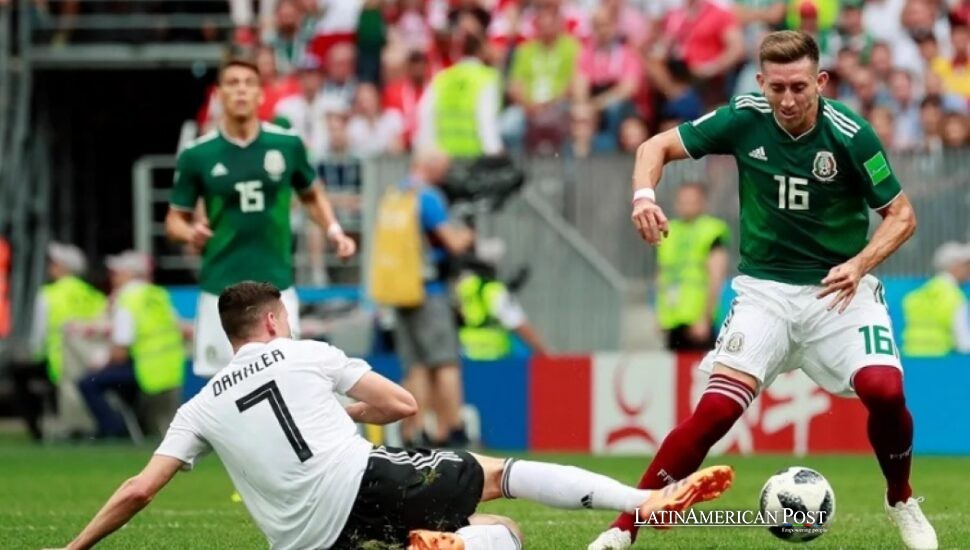
Then came Russia two thousand eighteen, when Mexico beat defending champion Germany one-zero in a match that shook the tournament’s first week. EFE’s reporting recalls the image of Julian Draxler and Héctor Herrera in that game. Still, the larger image belongs to Mexican football memory: green shirts running into space, a champion exposed, a country celebrating as if an old curse had cracked. Germany, the giant, went home in the group stage. Mexico advanced again. Then Mexico lost again in the round of sixteen.
That is why the twenty-eight defeats cannot be separated from the country’s emotional economy. Mexican football has lived for decades between pride and irritation. It is too strong to be treated as a guest and not strong enough to be treated as a favorite. It dominates much of Concacaf’s imagination, exports players, fills stadiums in Mexico and the United States, and carries one of the largest fan bases in the global game. Yet at the World Cup, the final leap remains missing.

Hosting Becomes a Geopolitical Stage
The 2026 World Cup changes the meaning of the record because Mexico will not merely qualify for the tournament. It will help stage it. As the first country to host World Cup matches for a third time, Mexico becomes more than a national team story. It becomes a geopolitical symbol inside a North American tournament shared with the United States and Canada, at a time when migration, trade, security, and cultural power shape the region as much as sport does.
The Estadio Azteca carries that symbolism better than any press release. It is not just a stadium. It is a cathedral of twentieth-century football, the place of Pelé’s triumph in nineteen seventy and Maradona’s fury in nineteen eighty-six. In two thousand twenty-six, it became a bridge between memory and negotiation. Mexico will stand inside a World Cup increasingly defined by money, logistics, broadcast power, and regional branding. The tournament will sell North America to the world. Still, Mexico will remind viewers that this continent’s football soul is not only corporate, suburban, or English-speaking.
That matters for Latin America. Mexico’s role is complicated because it is both Latin American and North American, both a regional bridge and a cultural heavyweight, both a football exporter and a football market. Its World Cup presence reflects a larger Latin American tension: how to remain culturally sovereign while integrated into economic systems dominated from the north. The Tri’s history of falling and returning becomes, in that sense, more than a sports biography. It resembles the region’s own political rhythm of setbacks, resilience, unfinished promises, and repeated reentry onto global stages that were not designed for it to dominate.
A strong Mexican run in two thousand twenty-six would not erase twenty-eight defeats. Nothing erases them. But it could change their meaning. At home, before its own people, Mexico has the chance to turn an ugly statistic into a narrative of endurance. The record would become less a tombstone than a scar: visible, permanent, but no longer the whole body.
When Mexico opens its campaign on June 11 at the Azteca against South Africa, the match will carry more than three points. It will carry nineteen thirty, nineteen fifty-eight, the long round-of-sixteen curse, the Germany victory, the Argentina heartbreak, and the restless demand of a public that has waited too long to see consistency become transcendence.
The twenty-eight defeats are real. They should not be softened into poetry. But they are also proof that Mexico kept coming back to the place where it was hurt. In football, as in history, that is not a small thing.
Also Read: Argentina’s Maradona Trial Brings Football’s Saint Medical Reckoning