Venezuelan Oil and Sai Baba Shape India’s New Power Play

Delcy Rodriguez’s India visit links Venezuelan oil, spiritual devotion, and global crisis diplomacy as New Delhi hunts crude beyond Hormuz and Latin America watches a wounded petrostate bargain for relevance after Nicolas Maduro’s U.S. abduction, according to Al Jazeera reporting.
A Pilgrimage With Oil in Its Luggage
Delcy Rodriguez arrived in India carrying two kinds of cargo. One was political, thick with barrels, sanctions, refineries, and the nervous math of a world energy market knocked sideways by war. The other was spiritual, more private but no less revealing: a devotion to Sathya Sai Baba, the late Indian guru whose image has traveled strangely well through Venezuelan power.
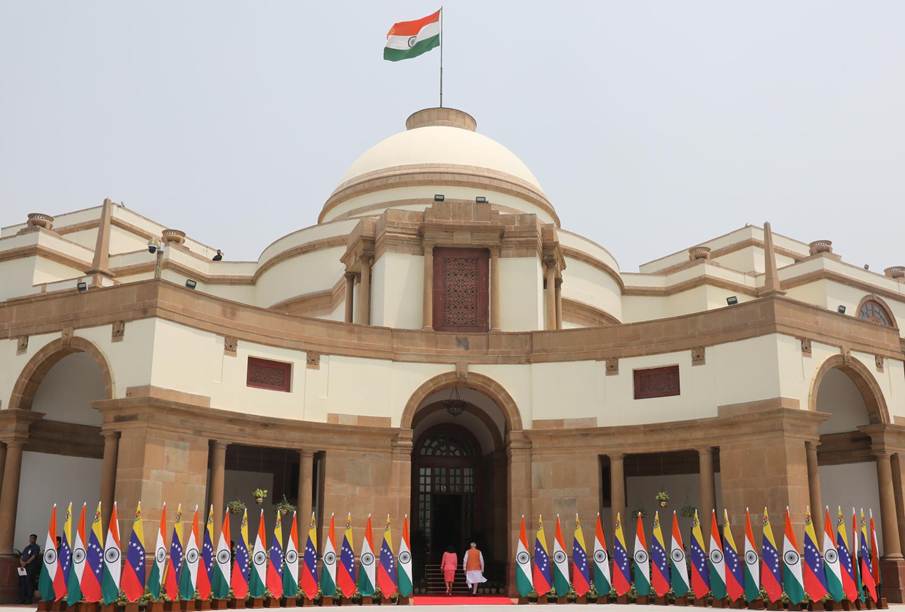
It is her first visit to India since becoming Venezuela’s interim president after democratically elected President Nicolas Maduro was abducted by the U.S. military in January, according to Al Jazeera. The official purpose is energy cooperation. India needs crude. Venezuela needs customers, legitimacy, cash flow, and room to breathe. The timing is almost theatrical.
New Delhi is scrambling to diversify imports after supply disruptions caused by the U.S.-Israel war on Iran and the effective Iranian blockade of the Strait of Hormuz. Nearly half of India’s crude normally moves through that narrow passage, along with major volumes of liquefied natural gas and petroleum gas. When Hormuz tightens, India feels it in its factories, fuel pumps, shipping costs, and political nerves.
Rodriguez’s five-day visit, then, is not ceremonial. It is a test of whether Venezuelan oil can slip back into the bloodstream of Asian energy markets at a moment when every barrel has become diplomatic currency.
Yet diplomacy is not her only stop. Rodriguez, a longtime devotee of Sathya Sai Baba, is expected to visit Puttaparthi, his birthplace in Andhra Pradesh. Al Jazeera reported that Rodriguez last visited in 2024 and has described the guru as a presence she felt in moments of danger, beside herself, her family, and her country. In an interview with the Sri Sathya Sai Trust’s official media channel, she said Baba was always with them, teaching and showing “a path for peace and love.”
There is something deeply Latin American in that mix of oil, crisis, mysticism, and statecraft. The region has long blurred the formal and the devotional, the presidential balcony and the saint’s candle. Power often arrives wrapped in symbols. Sometimes it wears a uniform. Sometimes it carries a relic.

The Guru Inside Venezuelan Politics
Sathya Sai Baba, born Sathyanarayana Raju in 1926 in Puttaparthi, built a global following around the teachings of unity, spirituality, peace, and nonviolence. At 14, he said he was the reincarnation of Shirdi Sai Baba, a revered Indian saint followed by millions. His slogan, “Love All, Serve All,” became the soft architecture of an international religious movement.
His followers included ordinary devotees as well as Indian cricketers, Bollywood stars, business leaders, and politicians. He was also controversial. Scientists accused him of faking miracles such as materializing rings and sacred ash. British lawmakers raised allegations in 2002 that he had sexually abused male children of devotees. A BBC documentary investigated an alleged abuse case in 2004, and The Guardian later reported that U.S. travel advisories about inappropriate sexual behavior by a prominent local religious leader referred to him. Sai Baba was never charged.
After he died in 2011, suitcases containing cash and gold were reportedly found in his lodgings, prompting fraud allegations. Officials from his Sri Sathya Sai Central Trust denied wrongdoing, saying he had no personal property and taxes were paid.
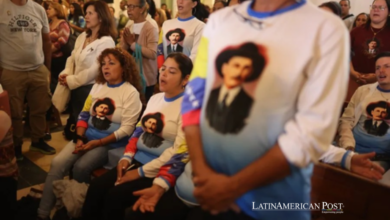
Still, in Venezuela, his influence found a warm political home. Al Jazeera reported that a 1974 Sai Baba center opened in Caracas and runs a “Human Values School.” Maduro himself was reportedly a devotee. Indian media cited a 2005 photo of Maduro and his wife, Cilia Flores, seated at Sai Baba’s feet. The Associated Press reported that after Sai Baba died, Maduro declared a national day of mourning and called him “a being of light” and a “beacon of unconditional love, selfless service and truth.”
Rodriguez has now brought that spiritual vocabulary into the presidency. During her first media briefing as interim president, she invoked Sai Baba’s teachings, speaking of coexistence, mutual respect, recognition of others, and the construction of “a new spirituality,” according to Al Jazeera.
For Venezuela, this language is more than an ornament. It helps soften a brutal transition after Maduro’s removal, offering healing words. At the same time, the country negotiates with the very power structure that helped isolate its oil sector. Spiritual phrasing can make geopolitical compromise sound like moral renewal.
That matters in Latin America, where political legitimacy is not only legal or institutional. It is emotional. It is sung, mourned, prayed over, and broadcast. Rodriguez’s Sai Baba devotion offers a bridge to India, but also a narrative for Venezuelans: survival through faith, continuity through sacrifice, sovereignty through reinvention.
Crude, Sanctions, and the New South
Venezuela holds an estimated 303 billion barrels of oil, about 17 percent of known global resources, according to figures cited by Al Jazeera. That is more than Saudi Arabia or the United States. But reserves are not powerful on their own. They become powerful only when a country can extract, refine, ship, insure, sell, and collect payment.
Years of U.S. sanctions and government mismanagement crippled Venezuelan production. Washington’s sanctions on PDVSA, the state oil company, forced Indian refiners and traders to sharply cut purchases. Before sanctions intensified in 2019, Venezuela was among India’s major oil suppliers. Indian state firms, led by ONGC Videsh, had entered Venezuela in 2008. By 2010, Indian consortia had stakes in projects such as Carabobo-1 in the Orinoco Oil Belt. In 2012, India even overtook China as the largest Asian importer of Venezuelan crude.
Now the old route is reopening under new pressure. After Rodriguez took power, her government signed a new oil supply agreement with the U.S., allowing a limited number of companies to buy Venezuelan crude directly from PDVSA. India’s Reliance Industries is especially important because its refinery can efficiently process Venezuela’s ultra-heavy crude. However, only a small number of Indian refineries can handle the heavy, sulfur-rich oil.
The numbers show the speed of the pivot. Venezuela has supplied India with about 417,000 barrels per day so far this month, up from 283,000 barrels per day in April, according to Kpler data cited by Al Jazeera. There had been no Venezuelan shipments to India during the previous nine months under Maduro’s socialist government. India’s total crude imports have risen to almost five million barrels per day amid the global supply crisis.
Rurendra Tandon, a secretary in India’s foreign ministry, said talks focused on “forging an energy partnership,” according to Al Jazeera. He said Venezuela sees India as a stable demander for years to come, creating “perfect complementarity” upstream and downstream. Discussions also touched on mining, animal husbandry, transportation, agricultural equipment, and pharmaceuticals.
For Latin America, the lesson is sharp. Venezuela is not returning as an ideological lighthouse. It is returning as a distressed energy giant with leverage because the world is short on secure crude. That changes the regional equation. Caribbean states will watch for fuel diplomacy. Brazil and Guyana will read the move through the lens of security and border anxieties. Cuba will see both opportunity and warning, since Venezuelan oil once helped hold its own system together.
Rodriguez’s India trip is therefore a snapshot of the new multipolar disorder. Washington still punishes and permits. India bargains across blocs. Venezuela sells survival as sovereignty. And Latin America, forever rich in resources and poor in negotiating unity, is reminded that oil can rescue a government. Still, it can also expose exactly how fragile that government has become.
* Adapted from an original report by Al Jazeera titled “Who is the Indian guru Venezuelan acting President Delcy Rodriguez follows?”: https://www.aljazeera.com/news/2026/6/4/who-is-the-indian-guru-venezuelan-acting-president-delcy-rodriguez-follows
Also Read: Venezuela’s Bolivar Meltdown Makes Dollars King and Workers Count Pennies