Venezuelan Judoka Trains Through Ruins Toward an Unbroken Olympic Dream
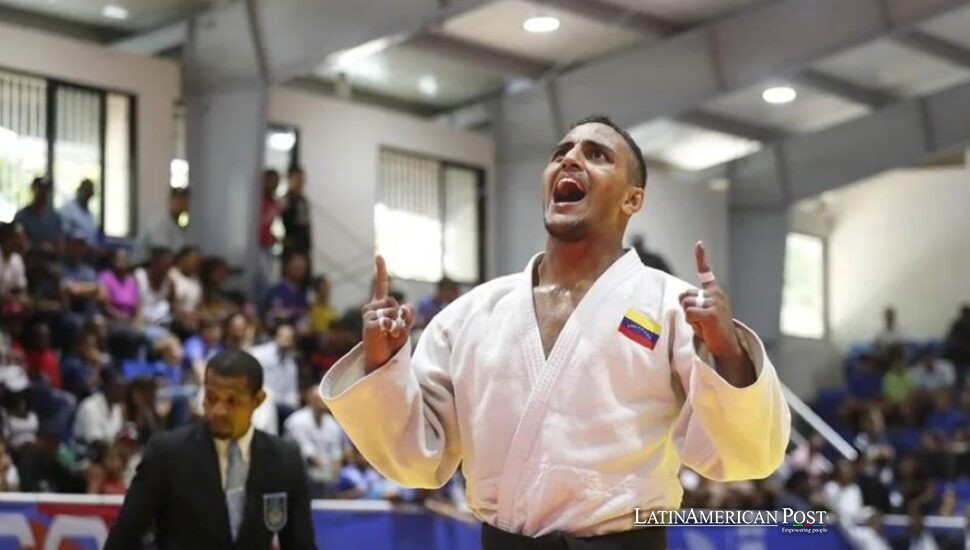
Jonhelius Patete kept training eight hours daily while earthquakes shattered homes across Venezuela. His bronze medal in Santo Domingo is more than progress toward Los Angeles 2028. It reflects a judo culture built on discipline, scarcity, memory, and stubborn hope.
The Mat Did Not Stop Moving
At 9:30 each morning, Jonhelius Patete begins with the unglamorous work. Weights. Resistance drills. Cardio until the body starts bargaining. In the afternoon, he returns for full judo sessions, repeating throws, grips, transitions, and falls until instinct replaces thought.
Some days beyond eight hours.
“We never stopped. Never, never, never,” the 22-year-old Venezuelan judoka told EFE.
That sentence might sound like familiar elite-sport language, the kind athletes repeat when medals are nearby. But Patete said it after two major earthquakes struck Venezuela on June 24, leaving more than 5,500 people dead, over 16,000 injured, and nearly 18,000 without homes, according to figures provided for the competition.
He was in Argentina when the earth moved back home. He had traveled to compete, carrying the narrow focus demanded by international judo, when images of collapsed neighborhoods and displaced families broke through his concentration. From a distance, he said, the suffering affected him “a lot.”
The return hurt more. Patete saw children and families without shelter. Yet he and the Venezuelan national team remained concentrated at the National Judo Center in Caracas, preparing for the Central American and Caribbean Games in Santo Domingo, which opened July 24.
He did what he has done since he was 5 years old. He trained.
There is courage in that repetition, but also a harder truth. Latin American athletes are often praised for resilience, even though the word describes what institutions fail to provide. Training after catastrophe is admirable. It should not romanticize damaged homes, limited sports budgets, or the expectation that young competitors turn national suffering into fuel.
Patete makes a more modest claim. He wants his performance to return “a smile and happiness” to Venezuelan children, he told EFE, and help them discover a sport that might briefly pull their attention from disaster. A medal cannot rebuild a house. It can restore a small piece of possibility.
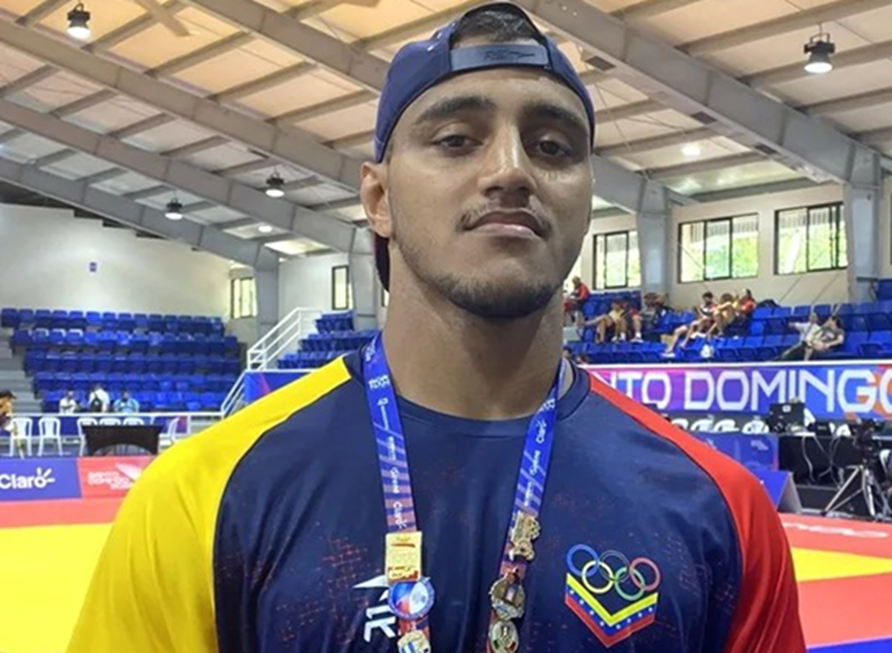
On Monday, Patete won bronze in the men’s under-90-kilogram division, defeating Cuba’s Naysdel Cardoso García. The medal arrived a little more than a month after the earthquakes. It was not the Olympic prize he had imagined, but it made visible the labor that continued even as Venezuela mourned.
“I have trained more than eight hours a day,” he told EFE. “The result has been seen. I have had international and national results, and I am the best in my country, number one in my category.”
A Tradition Carried by Women
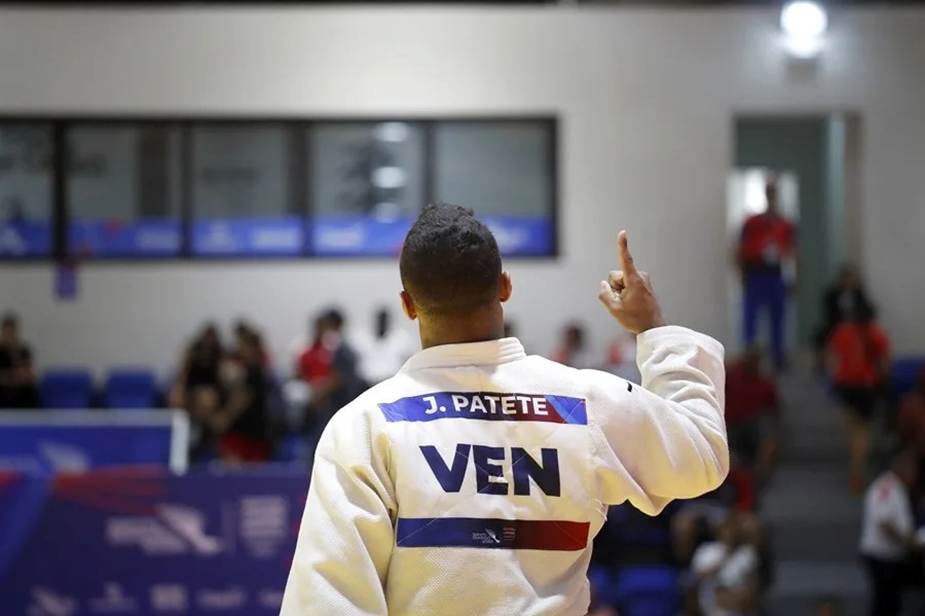
Patete first entered a gym as a small boy and fell in love with the judogi, the heavy white uniform that seemed both strange and elegant. Later, it was the sport’s discipline, constancy, and precision that kept him there.
“Discipline, more than anything, is focusing on a goal, on a dream that I want to fulfill,” he told EFE.
That dream did not emerge alone. Patete traces it to watching teammate Elvismar Rodríguez compete at the Rio 2016 Olympics in the women’s under-70-kilogram category. Her appearance gave the Games a Venezuelan face. Los Angeles stopped being an abstraction.
Venezuela’s judo tradition has often been carried most visibly by women. In 1984, Natasha Hernández became the country’s first world judo champion. Naomi Soazo delivered Venezuela’s first Paralympic gold medal in Beijing in 2008. A decade later, María Giménez won the nation’s first Youth Olympic gold in Buenos Aires.
Sporting traditions are not created by one victory. They form when one athlete makes the next athlete’s ambition seem reasonable. Hernández made a world title imaginable. Soazo widened the meaning of Venezuelan excellence. Rodríguez and Anriquelis Barrios, who finished fifth at the Tokyo Olympics, gave younger judokas examples to emulate and sometimes train alongside.
Patete stands inside that inheritance as the men’s program develops its own momentum. Willis García’s Pan American Games gold in Santiago in 2023, the first by a Venezuelan man, broke another barrier. His father had won bronze in 1991, turning one family’s record into a map of how slowly sporting breakthroughs can arrive.
This continuity helps explain why Venezuelan judo remains competitive despite having fewer resources than global powers. Its advantage is accumulated knowledge. Coaches pass down tactical habits. National-team athletes train close together. A champion’s technique becomes a lesson rather than a distant legend.
Leadership has mattered. Federation president and former champion Katiuska Santaella has helped nurture the tactical discipline and confidence of the women’s program. International Judo Federation school projects and coaching seminars have expanded access and modernized instruction. Elite athletes also travel to camps in Spain, Japan, and Austria because local grit cannot reproduce the depth of world competition.
The arrangement reveals both strength and fragility: talent survives at home, then travels abroad to sharpen.
The tradition is vibrant and resilient, but never comfortable. It depends on close coaching, family sacrifice, functioning public institutions, and athletes who accept uncertainty.
Los Angeles Beyond the Rubble
Patete’s recent path shows the gradual construction of an Olympic contender. He won gold at the 2025 Central American and Caribbean Senior Cup in San Salvador, took bronze at the 2025 Bolivarian Games in Lima, and finished seventh at the 2026 Pan American Open in Buenos Aires.
None of those results guarantees Los Angeles. Qualification is built through rankings, travel, health, repeated exposure, and the ability to peak without breaking. The 2027 Pan American Games in Lima will be a crucial test, the place where Patete says it will become clearer “who is going to the Olympic Games.”
If his body allows it, Patete imagines competing in three or four Olympics. One Games can be chased through adrenaline. Four require recovery, money, discipline, and patience.
His parents call before competitions with blessings and reminders not to surrender. Their voices belong to Latin American sport’s hidden infrastructure, the families carrying costs absent from medal tables.
Patete says Venezuelans are characterized by discipline and “the constancy of continuing to train to be the best,” even in the face of adversity. The phrase resonates in a country accustomed to improvising around crisis.
Still, suffering does not automatically create champions. Earthquakes do not strengthen athletes. Scarcity does not improve technique. Disaster steals safety, nutrition, sleep, and concentration.
What creates a champion is the response: the coach who reopens the dojo, the teammate who offers another round, the parent who calls, and the federation that finds a ticket.
In Santo Domingo, Venezuela fought near the front of a medal table led by Mexico while grief remained fresh. Patete carried neither the whole country nor a solution to its pain. That burden would be unfair.
He carried something smaller and more honest—a promise to keep moving with purpose.
Los Angeles is still two years away. Between Patete and the Olympic tatami stand rankings, injuries, funding, travel, and unforgiving qualification mathematics. Yet Venezuelan judo has always advanced through narrow spaces.
The ground moved. The mat remained. Patete bowed, took his grip, and trained once again.
Also Read: Paraguayan Keeper’s Sacrificed Jersey May Return After World Cup Heroics