Aracataca Boards a Culture Train Beyond García Márquez’s Yellow Butterflies
In Gabriel García Márquez’s hometown, a culture train invites children to paint futures beyond Macondo, while a teenage poet claims her inheritance. Aracataca’s encounter with art asks whether literary prestige can become lasting educational opportunity along Colombia’s Caribbean rail corridor.
A Blue Butterfly Takes Flight
Anderson is in a hurry to board. At 10, the fourth grader has plans extending considerably farther than the railway through Aracataca.
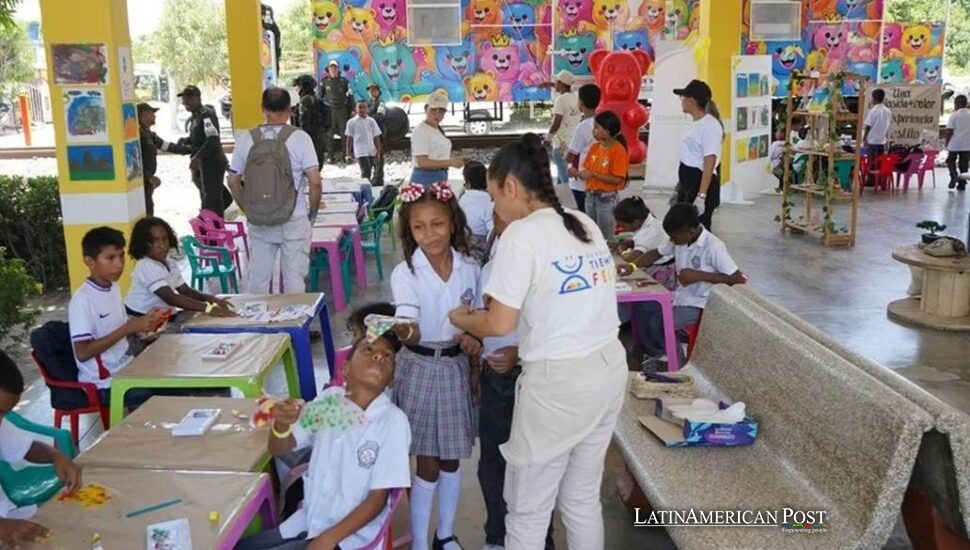
“I want to be an astronaut, to reach the moon and see Earth from up there,” he tells EFE while drawing a butterfly in different shades of blue on acrylic.
Blue, not the yellow associated with Gabriel García Márquez. It is a small distinction, but a useful one in a town whose children deserve futures larger than reproducing its most famous symbols. Anderson has another journey in mind first: Spain, where an uncle lives. His map runs through family before reaching outer space.
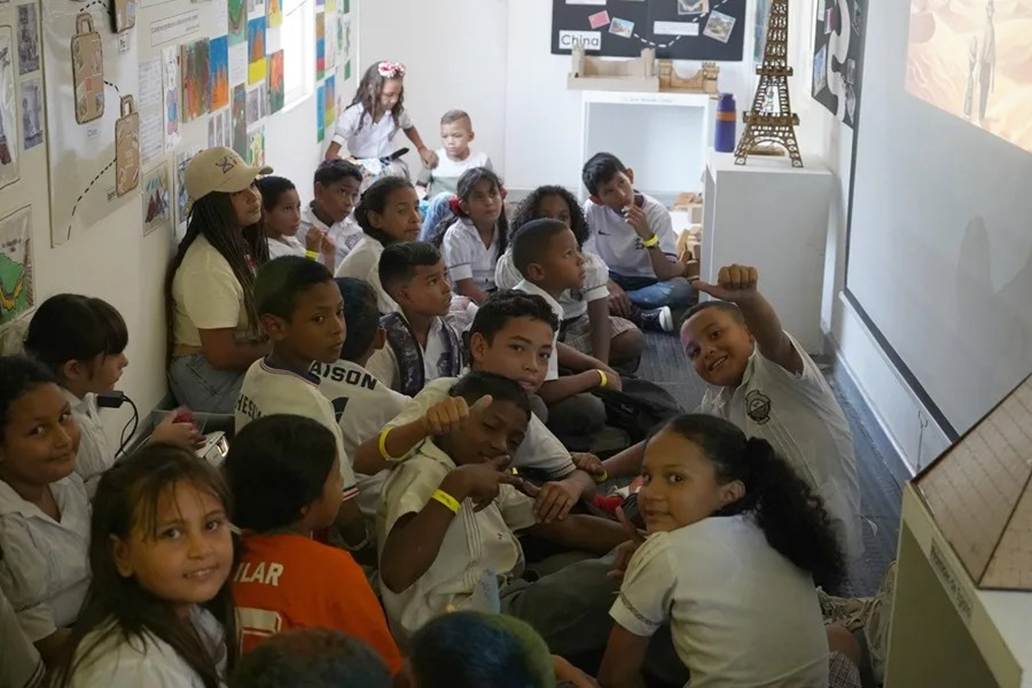
The carriage belongs to the Tren de la Cultura, or Culture Train, a traveling classroom organized by railway operator Ferrocarriles del Norte de Colombia, known as Fenoco, with the Tiempo Feliz and Cergui Art foundations. Spanish artist dEmo decorated the carriage, making the classroom itself part of the encounter with art.
Drawing and dancing make the invitation immediate. The carriage does not require children to approach culture as a finished masterpiece behind glass; it gives them something to do, and something to make.
Outside is Aracataca, in Magdalena, near the foothills of the Sierra Nevada de Santa Marta. Here, the station becomes a classroom, not just a landmark.
The timing gives the visit particular resonance. García Márquez, the 1982 Nobel literature laureate, was born here in 1927; his centenary arrives in March 2027. Commemorating that inheritance is one task. Ensuring children can use it without being confined by it is another.
Fenoco president Andrés Soto tells EFE he wants each child to discover that dreams can travel as far as the tracks. Anderson has already set his sights beyond them.
A Poet Beyond the Postcard
Ketieth Salazar arrives carrying something the train did not bring.
The 16-year-old has traveled from the outlying hamlet of Buenos Aires with a poem she wrote honoring García Márquez. Onstage, she recites verses about Caribbean heat, yellow butterflies and Macondo. Other children and adults applaud.
“Gabriel García Márquez is my main inspiration, and he taught us that dreams are also born in the most remote places,” she says in EFE’s reporting.
Her appearance complicates the familiar language of bringing culture to supposedly empty places. Ketieth was writing before she boarded. The event gives her an audience, not an imagination.
That distinction matters when evaluating the project’s ambition. Liany Certain, who heads Cergui Art, tells EFE it was conceived to “democratize art,” including in places where children do not even know what the word means.
Not knowing an institutional vocabulary, however, is different from lacking creative life. Ketieth’s poem makes the point without an argument. A program can widen access to materials, instruction and recognition while acknowledging that the communities receiving it already have stories worth hearing.
García Márquez’s own childhood offers a relevant precedent. His grandparents’ stories about violence and ghosts helped nourish the fictional world that made him famous. Local memory was not an obstacle he overcame on the way to literature. It was material he transformed.
Ketieth’s journey also exposes a practical limit. The classroom travels, but children in outlying settlements still have to reach its stops. Moving an institution closer is valuable; it does not automatically make access universal. Distance remains part of the story, even inside an initiative designed to overcome it.
More Than a Passing Visit
EFE’s account places Anderson alongside 150 other children at the Aracataca activities. Before arriving, the train had visited Santa Marta, Bosconia, Fundación and Sevilla. That makes five named communities, with Fenoco promising further expansion.
Five stops cannot show how many children remain outside the route. Attendance does not measure lasting learning. The meaningful distinction is between briefly bringing art closer and giving young people regular opportunities to develop their own creative interests.
The stronger measure will be continuity. Can participating schools keep activities going? Will children have materials and guidance between visits? Such questions do not diminish the visit’s pleasure. They distinguish an introduction from an educational relationship.
Diana Peláez, director of Tiempo Feliz, tells EFE that every child has the potential to transform their future when opportunities to learn and create are available. The crucial word is opportunities: plural, and preferably recurring.
The visit also revived discussion of Ruta Macondo, a proposal linking railway tourism with García Márquez’s legacy and local development. Its promise deserves attention without confusing visitor numbers with benefits for residents. A literary route could support local livelihoods; whether it does would depend on who participates and where spending stays.
Here the railway acquires a different meaning. Tracks carrying coal can also connect neighboring communities with cultural activities. That does not replace schools or guarantee prosperity. It demonstrates another possible use of infrastructure already passing through people’s lives.
Aracataca has supplied the world with an extraordinary fictional town. Its children should not have to become characters in somebody else’s nostalgia.
Anderson does not need to become another García Márquez. He needs room to follow his own questions. For the moment, those questions lead past a blue butterfly toward the moon.
Also Read: Uruguayan Legend Rubén Rada Made the Whole World Dance Candombe