First Ever World Cup Peruvian Expulsion and Chilean Red Card Reframe World Cup Folklore
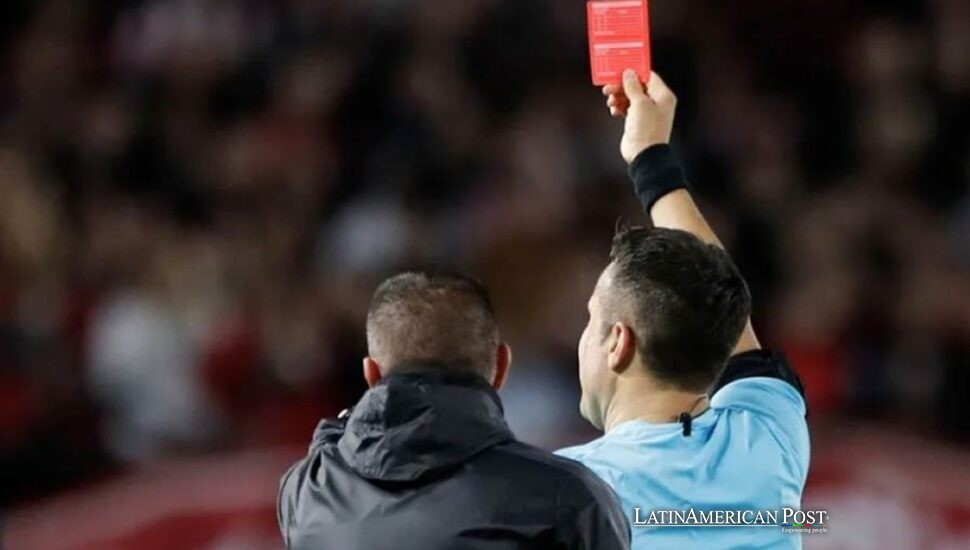
Before the red card became soccer’s theater of disgrace, a Peruvian vanished from a 1930 World Cup match, and a Chilean later made the punishment visible, turning Latin American players into unlikely custodians of football’s disciplinary memory and mythology.
The Ghost Before the Card
The first World Cup sending-off did not come with a flash of red, a roaring television close-up, or the modern choreography of outrage. It came in Montevideo on July 14, 1930, in Peru’s 3-1 loss to Romania, in a tournament still inventing itself as it went along. No shirt numbers. No universal visual card system. No slow-motion replay. Just a Chilean referee, Alberto Warnken, trying to control a match in which tempers rose after the hour mark and history slipped into a fog.
FIFA’s match report identifies Plácido Galindo, Peru’s captain, as the first player expelled in World Cup history. For decades, that was enough. The record had a name, a date, a country, and a place. Then came the old footballer’s memory, inconvenient and alive. In 2008, Luis de Souza Ferreyra, who scored Peru’s only goal that day, told El Comercio that the expelled player was not Galindo but Mario de las Casas, a broad, 6-foot-1 defender. “Lo vieron grande y le echaron,” he said, according to EFE’s notes and reporting. They saw he was big and threw him out.
That line carries the whole early World Cup inside it. The law was there, but so was improvisation. Authority had a whistle, not yet a television audience. Latin America was not merely participating in football’s new global ceremony. It was giving the sport some of its first controversies, its first legends, and its first arguments over who got punished, why, and how history remembers him.
Names Lost in the Dust
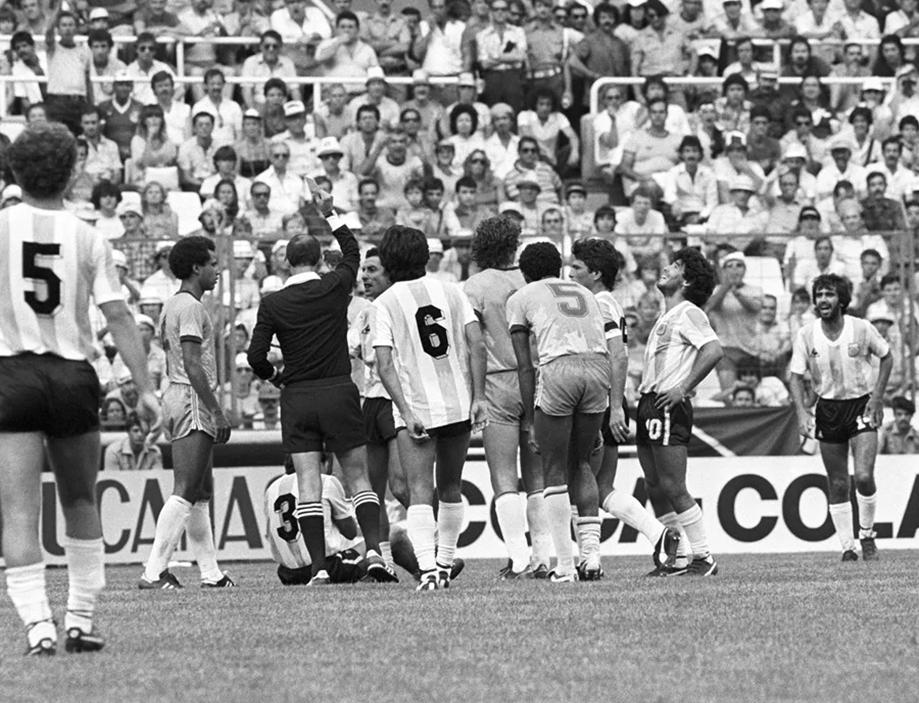
The uncertainty between Galindo and De las Casas is not a trivial archival quarrel. It tells us how Latin American football has often entered official memory, partly documented, partly misread, partly corrected by voices that arrive late from the margins. In 1930, shirt numbers had not yet reached the World Cup. Everton and Manchester City would not wear them in an official match until three years later, in the English Cup final. Numbering would not become part of the World Cup until 1950. In a packed, physical match, with no numbers and limited reporting infrastructure, confusion was not just possible. It was built into the system.
For Peru, the dispute matters because the first expulsion is not only a disciplinary statistic. It is a small window into the country’s early football identity, proud but peripheral, talented but often narrated by others. The 1930 Peruvian side was there at the beginning, before the World Cup became a corporate empire, before red cards became icons, before Latin American players were routinely packaged as either artists or hotheads. Whether the man expelled was Galindo, the captain, or De las Casas, the large defender remembered by De Souza Ferreyra, the episode marked Peru’s birth of football punishment.
That is why the story feels lived-in rather than dusty. There is the official version, neat and bureaucratic. There are the witness versions: physical and human. A big defender. A scuffle. A referee forced to decide. A player removed from the field before the world had invented the red rectangle that would later define the act. In Latin American football culture, where oral memory often wrestles with institutional records, the contradiction is almost too perfect. The first expelled player may be famous precisely because we cannot fully agree on who he was.
Caszely Made Punishment Visible
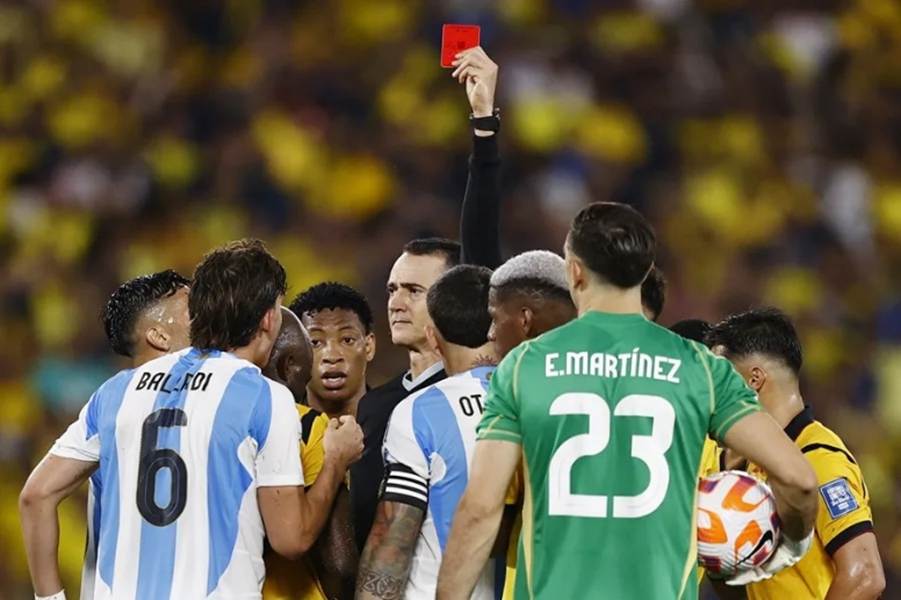
If Peru supplied the first World Cup expulsion, Chile supplied the first red card the world actually saw. On June 14, 1974, in West Germany, Carlos Caszely became the first player to be shown a red card for a physical offense in a World Cup match. The opponent was West Germany. The defender was Berti Vogts, known as “The Terrier.” The Chilean was Caszely, called “the manager of goals,” a forward by trade and temperament.
The irony still bites. The first visible red card in World Cup history was not shown to a defender hacking down a striker. It went to a Chilean attacker for kicking a German defender high on the thigh after repeated challenges. The world is upside down, as EFE’s notes put it. A finisher was punished for retaliating against a stopper. A Latin American forward reduced, in one gesture, to the global image of indiscipline.
But Caszely was never just a disciplinary footnote. In Chile, his name carried political resonance beyond the field. He was associated with a popular, working-class football imagination and, later, with public opposition to Augusto Pinochet’s dictatorship. That context does not excuse the foul, and it should not be forced into every reading of the incident. Yet it helps explain why Latin American World Cup expulsions rarely stay inside the chalk lines. They are absorbed into national stories about dignity, authority, rebellion, and humiliation.
The data deepens the pattern. Latin American players appear at crucial points in the World Cup’s history of punishment. Peru is tied to the first recorded expulsion. Chile is tied to the first physical red card. Argentina’s Pedro Monzón became the first player sent off in a World Cup final, against West Germany in 1990. Uruguay’s José Batista holds the record for the fastest World Cup expulsion, dismissed after 56 seconds against Scotland in 1986. Argentina’s Claudio Caniggia was sent off from the bench in 2002, proof that World Cup discipline had expanded from tackling bodies to policing dissent.
These cases should not be read as proof of some lazy stereotype about Latin American volatility. That is the old European gaze, the one that loves Latin flair until it becomes Latin fury. The better reading is historical. Latin American football developed in societies where class tension, fragile institutions, police authority, military memory, and neighborhood pride often shaped how players understood confrontation. The pitch became a public square with grass. Fouls were not only fouls. Protests were not only protests. Expulsions became rituals of power.
That is why the Peruvian and Chilean episodes still matter. They are not curiosities from distant tournaments. They show how the World Cup made rules global while leaving interpretation deeply human. A Peruvian may have been mistaken for another Peruvian because the game lacked numbers and the record lacked clarity. A Chilean striker made the red card famous because television-age football needed punishment to be visible, instant, and symbolic.
One disappeared into confusion. The other was marked in color. Together, they tell a Latin American story about soccer’s memory: official enough to enter the books, messy enough to survive outside them.
Also Read: Brazil’s Long Climb Back Continues With Ancelotti as Icons Blast Contract Renewal