Argentina Makes AI Surveillance the Newest Battlefield for Personal Privacy

Argentina’s expanding use of facial recognition, drones and social-media monitoring threatens more than data. It teaches citizens that protest, journalism and migration can trigger invisible scrutiny, turning democratic participation into a calculation of risk and privacy into a public freedom.
The Drone Above the March
Ana Tapia knows how surveillance feels because sometimes it hovers only feet overhead.
“When you walk, suddenly you see the drone in the air above your head,” Tapia said in Amnesty International testimony cited by EFE. “Why so close? Why is it so invasive?”
A drone need not arrest anyone to change behavior. It only has to make a pensioner wonder whether her face was stored, her companions mapped, or the next demonstration will carry an unseen cost.
Under President Javier Milei, Argentina spent $1.2 million between 2024 and 2025 on surveillance technologies, according to Amnesty. The purchases included social-media monitoring platforms, facial-recognition systems, drones, ground stations, thermal cameras and tools transmitting images in real time. Some sweep social networks, websites, the dark web and public databases, assembling information at a scale no human team could match.
That scale is the first privacy problem. Traditional surveillance was limited by labor and forgetfulness. Artificial intelligence removes those brakes. It can follow thousands, connect a face to a location, link a post to a protest, and turn routine into a searchable profile. What once required suspicion can now begin with everyone.
Consent offers little protection. Anyone entering an office, crossing a plaza or joining a march cannot negotiate with a camera. A notice does not explain which database is searched, how long information will be retained, who may receive it, or whether an algorithm is assigning a risk score. In public life, surveillance often presents itself as a condition, not a choice.

When Data Becomes Political Power
Amnesty based its report on 21 interviews with journalists, activists, pensioners, young people and human-rights defenders, plus procurement documents and information requests. The alarming finding was behavioral. Some journalists, activists and migrants said they had begun censoring themselves or reducing their presence at demonstrations because they feared identification.
That is how surveillance quietly succeeds. It does not need mass arrests if people preemptively silence themselves. It moves the checkpoint inside the citizen.
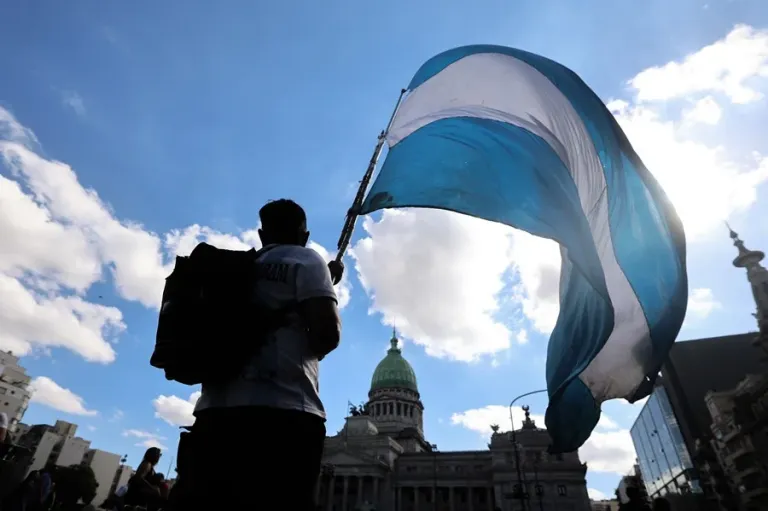
For Argentina, this is no abstract concern. Political life has long occupied the street, from labor marches and human-rights mobilizations to pension protests and neighborhood assemblies. Public space is where people without television studios, corporate influence or access to ministers make themselves visible. Monitoring that visibility as a potential threat tilts politics toward those who exercise power privately.
The second problem is false certainty. AI systems produce probabilities, not truth, yet officials may treat a match or alert as fact. Poor images, camera angles, uneven databases and design choices can generate errors. Once someone is labeled suspicious, reviewers may seek confirmation rather than question the machine. The result can be questioning, exclusion, investigation or an entry in a database the person does not know exists.
The third problem is unequal impact. Surveillance concentrates where authorities already expect disorder. Those locations generate more records, which justify more monitoring. Migrants, protesters and marginalized communities become overrepresented in the data, not necessarily because they offend more, but because the state watches them more closely.
Then comes function creep. A system purchased to monitor crime can be redirected toward political gatherings. Facial images collected for identification can later measure attendance or map associations. Social-media analysis can infer political interests, relationships, health concerns or financial distress, even when citizens never disclosed them. An inaccurate inference can still shape a real decision.
Matt Mahmoudi, Amnesty’s specialist in artificial intelligence and human rights, wrote that these tools have become part of an infrastructure of state control used to target dissent, discourage protest and harass marginalized groups, as EFE reported. The danger lies in the word infrastructure. Governments change. Databases, cameras and contracts remain.
Privacy Is Democratic Infrastructure
Defending privacy does not mean technology has no legitimate public use. A narrowly targeted system can help locate a missing person, protect a restricted facility or identify an immediate danger. But mass, continuous and secret monitoring reverses the democratic presumption. Instead of investigating a specific risk, it treats society itself as a dataset awaiting suspicion.
Argentina should adopt the limits Amnesty demanded: prohibit remote biometric recognition used for discriminatory mass surveillance and create binding rules for regulation, supervision and accountability. Every program should have a defined legal purpose, a necessity test, strict retention periods, secure access controls, independent audits and a public record of use.
People must also be told when an automated system influences a decision about them. They need a right to challenge a match, correct a record and learn which agency or contractor is responsible. “Human review” is meaningless when the reviewer merely follows the algorithm.
Privacy is often caricatured as a hiding place for wrongdoing. It is closer to breathing room. It allows a journalist to call a source, a migrant to seek help, a pensioner to march and a young person to read unpopular ideas without being silently classified.
The strongest democracy is not the one that can watch everyone. It is the one confident enough to leave innocent people unwatched. Argentina should choose that confidence before surveillance becomes so ordinary that citizens forget what freedom felt like without a camera overhead.
Also Read: Colombian Tiger Roars as Failed Peace Talks Lose Their Grip