South American Blue Macaws Find Unlikely Refuge Beneath Belgium’s Glass
Inside Belgium’s record-breaking Edenya greenhouse, two rare Lear’s macaw chicks have completed an extraordinary conservation trifecta. Their survival links a European zoo’s spectacle to South America’s disappearing habitats, wildlife trade, and the uneasy politics of saving nature far from home.
Two Chicks and a Global First
The newest record at Pairi Daiza does not hang on a wall. It sleeps, eats, and demands attention.
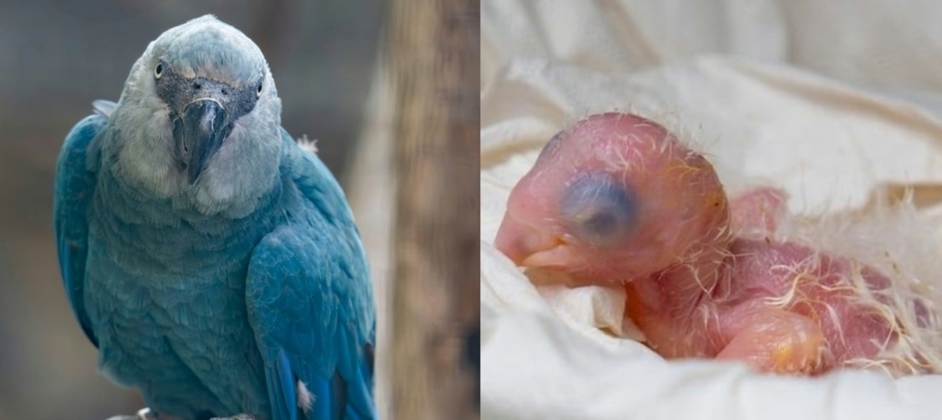
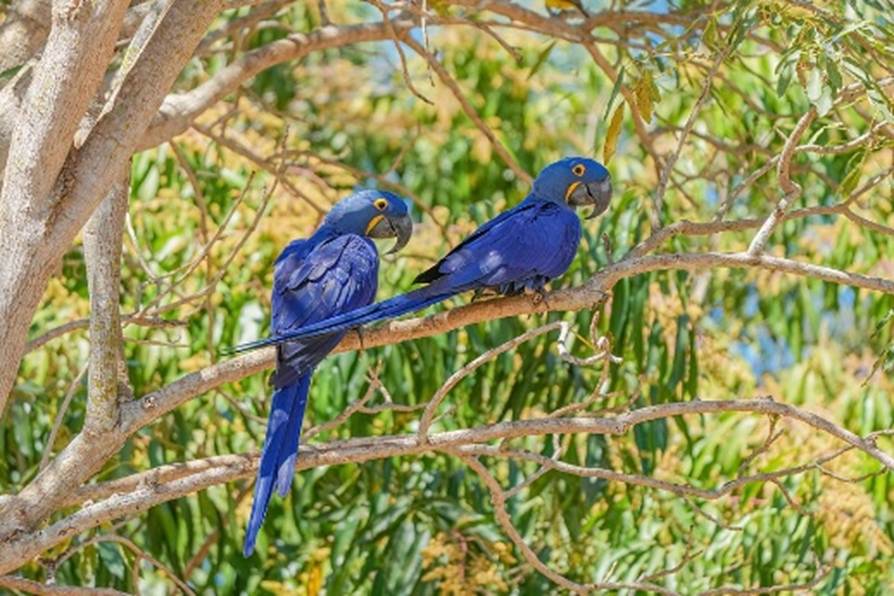
Two Lear’s macaw chicks hatched in early July inside the Belgian wildlife park. This birth made Pairi Daiza the only conservation center open to the public in the world to have successfully bred all three blue macaw species: the hyacinth macaw, Spix’s macaw, and Lear’s macaw. All are native to South America.
The chicks arrived only after failure. The previous year, a young Lear’s macaw pair produced eggs but broke them inside the nest. Chloé Meunier, a keeper specializing in rare birds, told EFE that the adults were “a little clumsy.” When eggs appeared again, the staff removed them quickly and placed them in an incubator. They were fertile.
What followed was less glamorous than a world record. It was an alarm clock every three hours, through daylight and darkness.
“At first, we fed them every three hours, day and night,” Meunier told EFE. She and her partner were exhausted. Then the intervals stretched to four hours, later five. Now the chicks eat three times daily.
Conservation becomes real through repeated acts: warmth, food, monitoring, someone awake at 3 a.m.
Lear’s macaws are endangered and native to a narrow area of northeastern Brazil. Their successful reproduction remains unusual in conservation centers. Pairi Daiza’s achievement is therefore meaningful. It creates a living reserve of a species whose future cannot be taken for granted.
Yet the location matters. These distinctly South American birds are multiplying under European glass, thousands of miles from the landscapes that shaped them. That fact is hopeful and uncomfortable. It demonstrates what expertise, money and long-term planning can accomplish. It also reveals how frequently emergency care for Latin America’s biodiversity is financed, displayed and celebrated elsewhere.
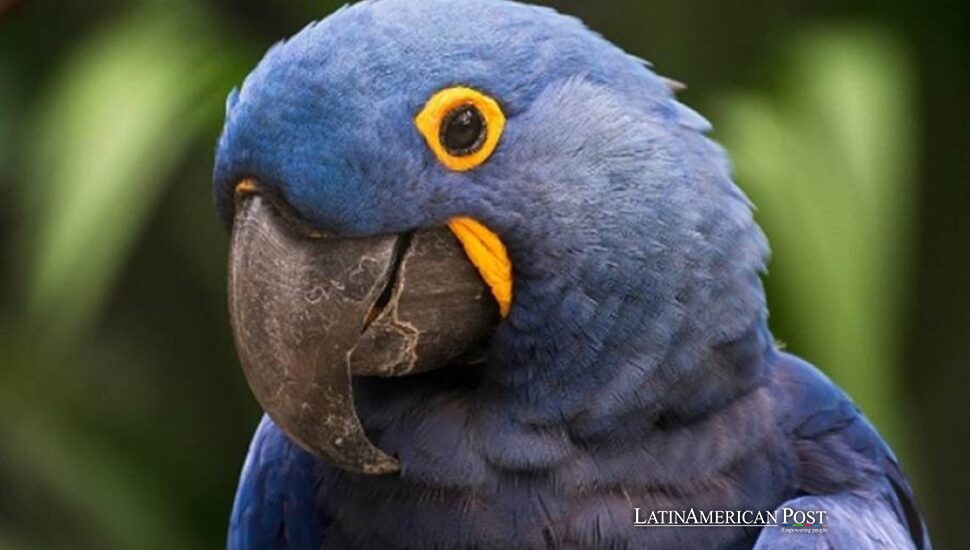
The three blue macaws carry different versions of the same warning. The hyacinth macaw, the largest macaw in the world, survives in parts of Brazil, Bolivia and Paraguay. Spix’s macaw, made globally famous by the film “Rio,” disappeared from the wild before reintroduction efforts began. Lear’s macaw remains tied to a specific Brazilian habitat. Extinction rarely arrives as one dramatic event. It advances through lost nests, burned forests, trafficked animals, and reduced breeding populations until a hatchling becomes international news.
A Rainforest Built for Records
The chicks live inside a project designed to overwhelm the senses.
Edenya rises beneath a glass dome roughly 200 meters long, 200 meters wide and more than 20 meters high. Since opening in February, the complex has claimed three Guinness World Records: the largest tropical greenhouse, the largest indoor zoo and, most recently, the largest indoor botanical collection.
On July 20, Pairi Daiza secured the botanical record after seven years of research. Its staff documented 1,675 plant species, surpassing the 1,100 species recorded at England’s Kew Gardens for the previous mark. Guinness required not merely a list, but a photograph of every species.
“When we began building this greenhouse, we never imagined it would become the largest in the world,” curator Steffen Patzwahl told EFE. Nor, he added, did the team expect it to hold the world’s largest collection of living plants inside a greenhouse.
Patzwahl spent seven years directing a plan that combined plants, animals, architecture and culture. Its references range from Asia and Europe to San Agustín in Colombia and feathered ceremonial clothing associated with Indigenous Brazilian communities.
The result is not a conventional row of cages. Jaguars, hippos, sharks and manatees occupy environments where barriers are intentionally difficult to see. Bastien Guindo, head keeper, told EFE that the absence of visible physical boundaries helps animals feel less completely enclosed. He described the recently arrived manatees as Edenya’s central attraction.
Visitors can sleep beside them. Eight of the greenhouse’s 88 underwater rooms have windows facing the manatee pool, while a restaurant looks into a shark habitat. Pauline Boisdenghien, Pairi Daiza’s operations manager, told EFE that families can watch manatees swim from their room.
For tourists, this is wonder packaged as proximity. Mateo Núñez traveled from Logroño, Spain, with his family, who enjoy theme parks. He called Pairi Daiza “absolute madness” and a place to discover, telling EFE that expectations were high.
The spectacle is part of the conservation model. Admissions, meals, and overnight stays help sustain the institution that cares for them. A child who watches a manatee through a bedroom window may leave with a relationship to a species previously known only in pictures.
But immersion can blur uncomfortable distinctions. Hidden barriers remain barriers. A South American forest recreated in Belgium is still a curated environment, assembled from plants, symbols and animals selected for visitors. Cultural references can educate, yet they can also reduce vast, living societies to mere atmospheric decoration.
That tension does not invalidate Edenya. It makes the project more revealing. Modern conservation must compete for attention in an entertainment economy. Pairi Daiza answers by making biodiversity spectacular. Its challenge is ensuring the spectacle leads visitors back to the real places, peoples and political choices on which those species depend.
The Birds Still Belong to the Continent
The blue macaws did not evolve beneath a dome.
Hyacinth macaws inhabit South American river systems, forests and palm savannas. Their powerful beaks crack hard nuts and seeds. Their cobalt feathers and yellow facial markings have made them valuable in the wildlife trade. Habitat destruction and fires add another layer of risk. Bolivia placed the bird on its 100-boliviano banknote in 2019, turning vulnerability into a national emblem.
A banknote, like a Guinness certificate, can create recognition. Neither can protect a nest by itself.
That is the deeper meaning of Pairi Daiza’s success. Captive breeding can preserve genetic lines, refine difficult reproductive techniques and provide insurance when wild populations collapse. In the case of Spix’s macaw, a species once extinct in nature, such work became essential to any possible return.
Still, breeding birds in Belgium cannot restore northeastern Brazil’s damaged habitats, prevent fires in the Pantanal or dismantle illegal wildlife markets. The chicks are a safeguard, not a substitute for the continent.
Durable conservation would connect Edenya’s expertise and resources to institutions and communities in Brazil, Bolivia, Paraguay and elsewhere in South America. Protection must include habitat, enforcement and livelihoods for people living beside nesting grounds. Otherwise, the world risks perfecting the art of saving species after removing them from the conditions that made them wild.
For now, the Lear’s macaw chicks are alive. Their feeding schedule has eased. The keepers sleep a little longer. Visitors pass beneath a roof containing 1,675 plant species and three Guinness records, perhaps unaware that the rarest achievement is breathing somewhere nearby.
Pairi Daiza has proved that all three blue macaws can reproduce under its care. The harder record will never fit neatly on a plaque: whether these birds continue to fly over South American landscapes, not merely survive as precious blue lives beneath European glass.
Also Read: El Salvador’s Turtle Guardians Turn Egg Trade Into Coastal Survival