Angelina Jolie Meets Her Horned Spider Namesake in Ecuador’s Andes
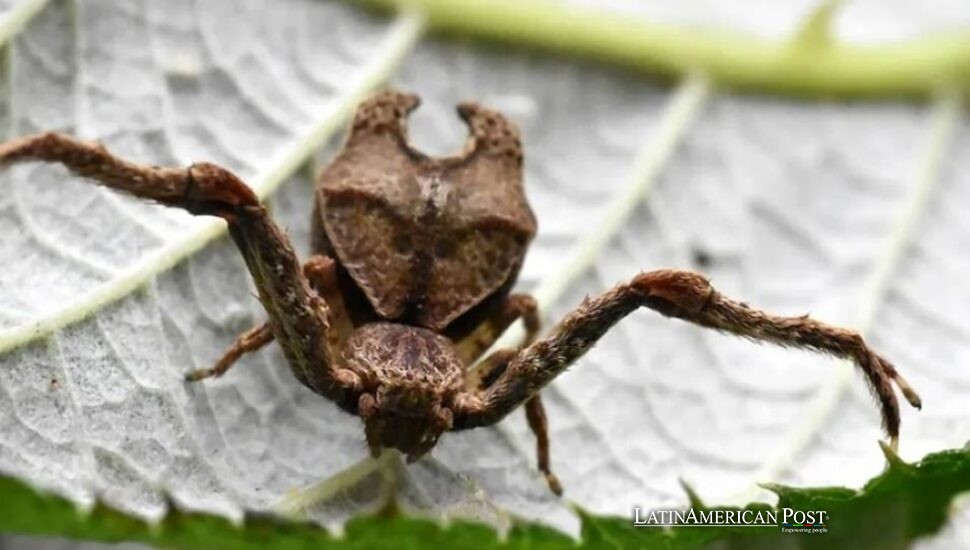
A crab spider named for Angelina Jolie has put Ecuador’s hidden biodiversity in the spotlight. At the same time, a record Galápagos mangrove finch breeding season reveals a harder truth: discovery attracts headlines, but survival depends on years of patient, expensive, sustained fieldwork.
A Celebrity Name With Scientific Weight
The spider is small, but the machinery around it is enormous.
Researchers David R. Díaz-Guevara and Miguel Machado found two undescribed crab spiders in Ecuador’s Andean ecosystems. One, Sidymella malefica, came from Baños de Agua Santa in Tungurahua. Its curved abdominal projections reminded them of the horns worn by Maleficent, the Disney character played by Angelina Jolie. The name also honors Jolie’s advocacy, her support for UNESCO’s Women for Bees program.
Celebrity taxonomy can look frivolous, but it has a purpose. A spider linked to Angelina Jolie crosses borders instantly, reaching donors, editors, and officials who decide which pieces of nature receive money and protection.
Yet naming is never neutral. Sidymella malefica carries pop culture into an Ecuadorian landscape, while the second species, Sidymella ayahuma, turns toward local cosmology. Found in the Mashpi Reserve in the Andean Chocó northwest of Quito, it is named for Ayahuma, the ceremonial Andean figure associated with Inti Raymi, spiritual force, and connection to nature.
One name invokes Hollywood’s dark fairy queen, the other an Andean being predating the republic. Ecuadorian biodiversity is presented through celebrity and Indigenous memory, two different routes to recognition.
Latin America has long supplied the world with specimens, raw materials, and stories whose prestige was often assigned elsewhere. Naming a species for a local cultural figure pushes against that history. Naming another for Jolie may attract attention that the research would otherwise never receive. What matters is who benefits once attention arrives.

Five Spiders and a Vast Blind Spot
Before this study, Ecuador had recorded only three species of Sidymella. The two discoveries raise the national total to five, an increase of roughly 67 percent in a single publication. That does not mean the country suddenly gained more spiders. It means science had been looking through a narrow keyhole.
Arachnids remain poorly studied compared with birds and large mammals. Yet spiders help regulate insect populations and reveal how habitats are structured. Finding two new species in well-known conservation landscapes suggests that Ecuador’s biodiversity inventory is still radically incomplete.
Sidymella ayahuma makes the point with comic precision. So far, researchers have found only one female specimen. That lonely data point can be read in two opposing ways. The spider may be rare, restricted to a small ecological niche, and therefore vulnerable. Or it may be more common but rarely detected due to limited sampling. Either possibility argues for more research, not instant certainty.
This is where the romance of discovery meets the economics of conservation. Describing a species requires trained taxonomists, museum collections, field access, and years of comparative work. Protecting it requires stable institutions, long-term monitoring, land management, and communities able to see conservation as an asset rather than another rule imposed from Quito.
Ecuador’s geography magnifies the challenge. The Andean Chocó, the eastern slopes, and the Galápagos compress extraordinary biological variety into a small country. That abundance also creates a funding problem. Every newly described species expands the moral inventory. It adds another life form that can be lost before the state understands where it lives.
Hope in Galápagos, Written in Mangrove Branches
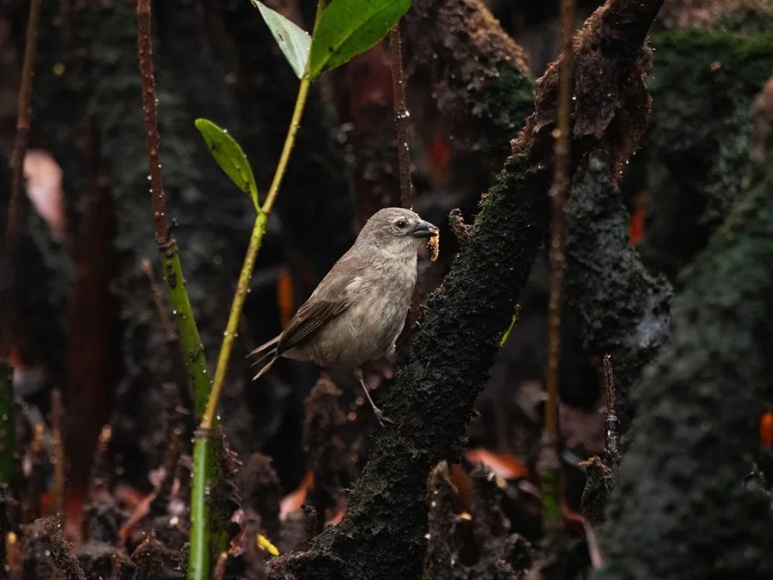
The mangrove finch offers a different kind of biodiversity story. It is not newly discovered. It is being kept alive.
In 2026, scientists and park rangers documented 25 chicks and 20 active breeding pairs, the strongest reproductive season since monitoring began in 2011. In 2025, there were 11 breeding pairs. The rise to 20 represents an increase of more than 80 percent, a number large enough to justify hope and small enough to demand caution.
The surviving population is confined to mangrove remnants at Playa Tortuga Negra and Caleta Black on northwestern Isabela Island. That narrow range turns every nest into a fragile national asset. One invasive predator, one extreme season, or one disease outbreak can carry consequences far beyond a single breeding cycle.
For seven weeks, teams located nests high in black and white mangroves, banded birds, installed acoustic recorders, and controlled rats, feral cats, and Philornis downsi, the introduced fly whose larvae attack chicks. They also supplied treated cotton and fibers that adult birds carried into nests. The technique, called self-fumigation, reduced the parasite burden without requiring workers to handle every chick directly.
There is no movie-star glamour in that labor. It is repetitive, technical, humid, and easy to understand. Yet it produced measurable results. Twenty active pairs generated 25 documented chicks, roughly 1.25 chicks per pair. Favorable La Niña conditions over the past three years may have helped. Still, weather alone cannot explain nests protected from invasive species or the accumulated knowledge of 15 years of conservation.
The lesson running from Baños to Mashpi to Isabela is simple and politically inconvenient. Ecuador does not lack natural wonders. It lacks the luxury of assuming they will endure on reputation alone.
Angelina Jolie’s name may bring the spider an audience. Ayahuma may root another species in Andean memory. The finch, meanwhile, shows what happens after the headline fades: people return to the mangroves, count nests, fight parasites, and begin again. Discovery gives biodiversity a name. Persistence gives it a future.
Also Read: The Untold Story of How a Will Smith Shoot Led to an Ecuador Amazon Anaconda Discovery