The Untold Story of How a Will Smith Shoot Led to an Ecuador Amazon Anaconda Discovery
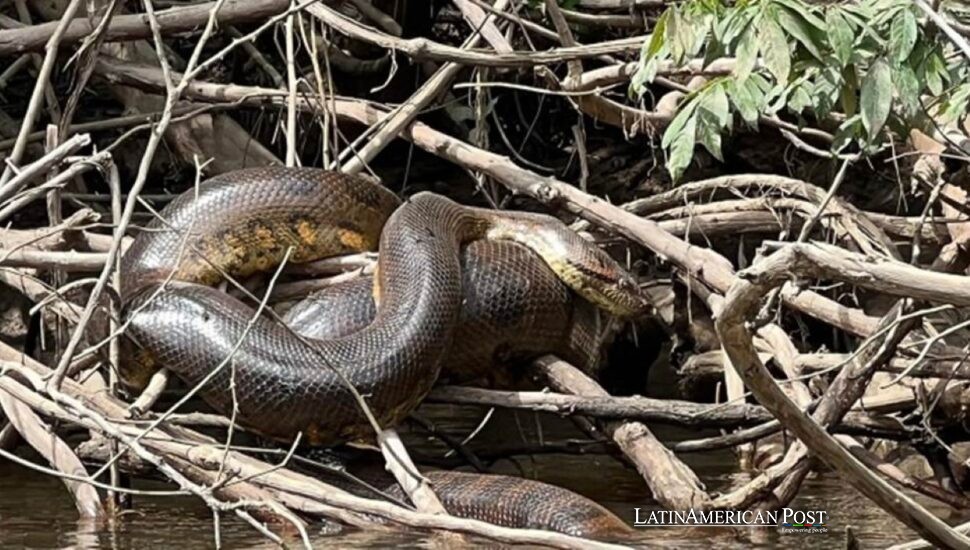
A giant anaconda found in the Ecuadorian Amazon during Will Smith’s National Geographic shoot is more than a wildlife marvel. It exposes Latin America’s oldest bargain: global wonder drawn from Indigenous territory while forests, rivers, and sovereignty absorb the bill.
A Sacred Snake Meets a Streaming Camera
The story begins almost too neatly for the age of nature television: a Hollywood star, a National Geographic crew, a remote river, and a snake so large it seems to belong to rumor. But in Baihuaeri Waorani Territory, in Ecuador’s Bameno region, the animal was not a rumor. It was known. It had been watched, feared, respected, and folded into Waorani life long before the scientific name Eunectes akayima arrived.
Professor Bryan Fry of the University of Queensland led the expedition, according to interviews and quotes credited to the university. The scientists came only after what Fry called a “rare invitation” from the Waorani, whose hunters guided them for ten days by canoe through water where the snakes wait nearly invisible. The team found several northern green anacondas in the shallows—one female measured 6.3 meters. Waorani accounts tell of others stretching beyond 7.5 meters and weighing about 500 kilograms.
That number is the kind that travels fast online. It feeds the old appetite for monstrous Amazon stories, the giant snake as a click, a trophy, and a nightmare. Yet the deeper news is not that the anaconda may be the largest in existence. It is that a creature this famous could still be misnamed by science, living inside a continent whose biodiversity is both celebrated and chronically undercounted.

The Data Bite Harder Than the Snake
The paper in the journal Diversity (https://www.mdpi.com/1424-2818/16/2/127) gives the spectacle its harder edge. Genetic sampling across nine countries found that what many people call the green anaconda is not a single story. The northern and southern green anacondas appear to have diverged almost 10 million years ago. Fry said they differ genetically by 5.5 percent, more than twice the often-cited genetic gap between humans and chimpanzees.
That comparison is not just a neat line for headlines. It punctures a lazy habit in conservation, especially in Latin America, where vast habitats are often treated as if scale itself guarantees safety. A snake ranging across the Amazon, Orinoco, and neighboring watersheds can look secure on a map. But a map can lie—rivers separate histories. Flooded forests hide lineages. A “least concern” label can flatten local vulnerability into continental comfort.
The study also challenges smaller anaconda classifications, suggesting some named forms may be better understood together. That matters because taxonomy is not academic bookkeeping. It decides which animals get attention, which wetlands get priority, which governments can postpone action, and which communities are told that the species they know intimately is already understood by outsiders.
For Latin America, the findings land in familiar territory. The region is rich in life and poor in institutional continuity. Scientific work crosses borders that politics keeps hardening. Environmental rules can change with elections, commodity prices, and court fights. A snake does not care where Ecuador ends, and Peru, Colombia, or Brazil begins. Oil, mercury, cattle, soy, and roads often do not care either.
A Continent Asked to Choose Again
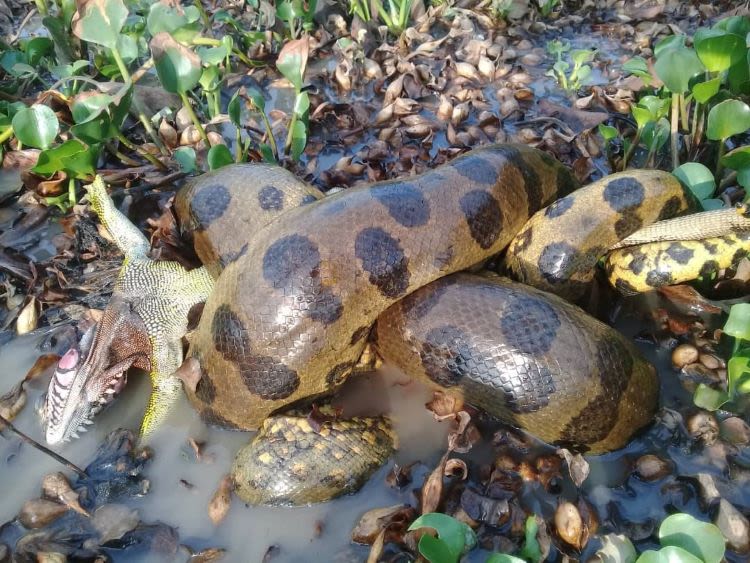
The northern green anaconda is now a symbol, but not the soft kind. It represents a living archive from the Miocene, surviving in water systems now under pressure from the modern extractive economy. The notes from The University of Queensland indicate 20 to 31 percent habitat loss due to agricultural expansion in the Amazon basin, with up to 40 percent of forests potentially affected by 2050. Mining pollution, land fragmentation, drought, fires, and climate change crowd the same picture.
In Ecuador and across Latin America, this is the central contradiction: nations are asked to protect planetary treasures while also servicing debt, building roads, funding schools, and selling what global markets demand. The Amazon becomes a museum, a pharmacy, a carbon sink, an oil field, a sacred territory, and a national budget line all at once. Outsiders prefer the first three. Governments often depend on the last two. Indigenous peoples are left to live with the consequences.
That is why Waorani authorship on the scientific paper matters. It is not a decorative inclusion. It pushes back against the old expedition model in which Indigenous knowledge opened the forest and foreign institutions owned the discovery. Here, the people who considered the snake sacred were collaborators, guides, and co-authors. The language of science still carries power, but the doorway into the river was theirs.
There is also a warning for entertainment. A Will Smith series can bring attention that a technical paper never would. Attention can help. It can also simplify. The camera loves the enormous body on the riverbank. The harder story is chemical: Fry’s next concern is heavy metal pollution and petrochemicals from oil spills, especially their effects on fertility and reproductive biology. A giant snake can survive a jaguar. It may not survive poisoned reproduction.
So the Ecuadorian Amazon has offered the world a revelation with teeth. A new species has been named, but an older truth has surfaced. Latin America’s future will not be measured only in hectares saved or barrels pumped. It will be measured by whether countries can defend the knowledge held by their rivers before those rivers are made unreadable.
The anaconda was never waiting to be discovered. It was waiting for the rest of us to catch up.
Also Read: Puerto Rico Bets on AI Classrooms Before the Future Arrives