Argentina Students March Again as Milei’s University Cuts Test Democracy
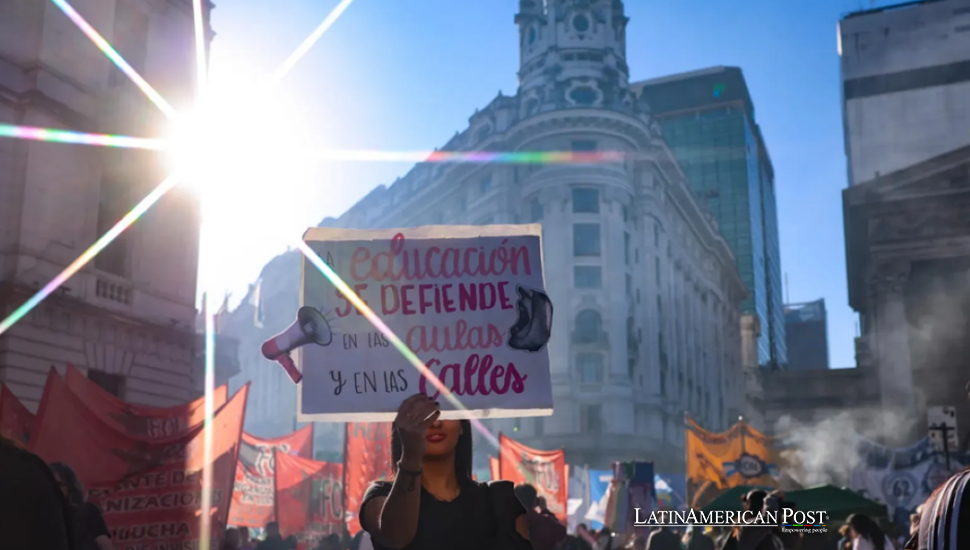
Argentina’s public university crisis has spilled into the streets, where students, professors, doctors, and families are challenging Javier Milei’s austerity project and defending a model of free education that long promised mobility in a region defined by inequality.
A Nation Marches for Its Classrooms
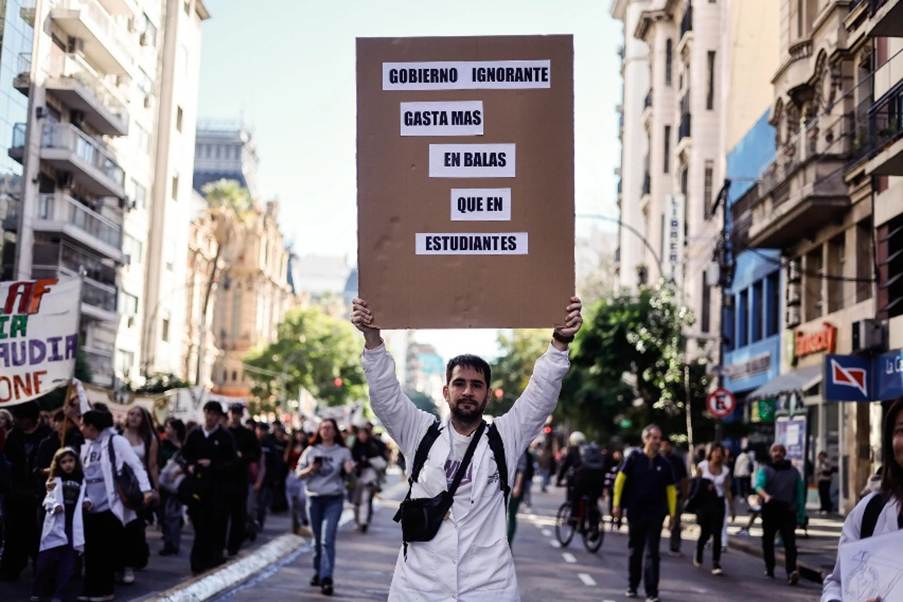
By Tuesday afternoon, Buenos Aires had the feel of a country trying to remember what it still believed in. Students came with backpacks and painted signs. Professors came with tired faces, the kind earned after months of shrinking salaries and larger classes. Hospital workers came in their uniforms. High school students came because the crisis no longer felt abstract. It had moved closer, almost to the front door of their future.
The Federal University March filled the streets around Argentina’s public campuses before moving toward Plaza de Mayo, the symbolic center of Argentine political pressure, facing the Casa Rosada. Similar protests spread through other cities. Under the slogan “For education, public universities, and national science,” demonstrators demanded that President Javier Milei’s government comply with the public higher education funding law, which his administration has refused to implement.
Organizers said 1.5 million people mobilized across the country. Even in a nation accustomed to mass protest, that number carries political weight. It suggests that the fight over universities has become more than a budget dispute. It has become a referendum on what kind of state Argentina wants to keep after years of inflation, frustration, broken promises, and ideological whiplash.
Emiliano Yacobitti, vice-rector of the University of Buenos Aires, told EFE that the march represented Argentines demanding that professors and university workers be able to live with dignity from their labor. The public university, he said, remains the country’s main tool for social mobility. His accusation was blunt: this government is gutting quality public education.

Austerity Reaches the Lecture Hall
The data behind the anger is stark. According to the Ibero-American Center for Research in Science, Technology, and Innovation, Argentina’s university budget fell from 0.718 percent of GDP in 2023 to 0.428 percent this year, its lowest level since 1989. That is not trimming fat. That is cutting into muscle, memory, and national capacity.
Since taking office in late 2023, Milei has made fiscal balance the core of his political identity. To his supporters, the austerity shock is the bitter medicine needed after decades of Argentine economic disorder. To his critics, it is an ideological experiment that treats public institutions as obstacles rather than foundations. Universities now sit at the heart of that confrontation because they are one of Argentina’s most powerful democratic symbols.
Free public university education has existed in Argentina since 1949. Over time, it helped build one of Latin America’s most respected higher education systems, with about two million students enrolled in 57 public universities. The University of Buenos Aires is not only the country’s largest university, but also one of the most prestigious. It is a regional magnet, a place where Argentines and foreigners have long imagined knowledge as a public right rather than a luxury.
That is why the cuts strike so deeply. They are not only administrative. They reshape the social contract. When salaries fall below the poverty line, professors leave. When professors leave, classes disappear. When classes disappear, students delay their degrees or drop out. When scholarships are insufficient, working-class students are asked to perform a miracle: study, work, travel, eat, pay rent, and still believe the future is open.
Medicine student Guido Marotta told EFE that dropout rates are already high because professor resignations reduce the number of available classes. In contrast, students are increasingly forced to work to survive. Without scholarships, he said, many cannot combine study and work, so they abandon their careers. That is how austerity becomes hereditary. It not only reduces this year’s spending but also narrows who will be able to become a doctor, engineer, teacher, scientist, nurse, lawyer, or researcher ten years from now.
The Hospital as a Warning
The crisis is also visible beyond lecture halls. Public hospitals affiliated with universities are struggling with shortages of supplies, infrastructure, and staff. At the Hospital de Clínicas, part of the UBA, administrative worker Karen Rivero Carrizo told EFE that patients arrive from all over the country. Still, doctors cannot operate because supplies are in short supply. The budget crisis, she said, affects the training of doctors and nurses who later serve Argentina’s most distant regions.
That detail reveals the scale of the problem nationwide. A university hospital in Buenos Aires is not merely a local institution. It is part of the machinery that trains professionals for provinces, rural towns, and border regions where the state is often thin and private options are limited. If that system weakens, the damage travels. It reaches patients who never marched, towns that never appear in the headlines, and families who may not care about ideological battles until the clinic has no doctor.
There is also a regional meaning. Latin America has often been told that development depends on discipline, openness, efficiency, and market confidence. But countries do not become stronger by starving the institutions that produce human capital. In a region competing for technology investment, medical capacity, scientific research, and leadership in energy transition, Argentina’s university crisis is a warning to the continent. Fiscal order matters, but a country that balances accounts by dismantling its knowledge base may win a spreadsheet and lose a generation.
That is why foreign students were also in the crowd. Brazilian psychology student Thais Caixeiro told EFE she came to Argentina in 2024 because the UBA is the best university in Latin America, and she wants to graduate. Yet she described bathrooms without toilet paper and professors whose salaries do not cover half the rent. Her testimony captures the humiliation inside the numbers. Prestige survives for a while on reputation. Then the lights flicker, the paper runs out, and the myth begins to crack.
Milei’s party, La Libertad Avanza, dismissed the march as a political opposition mobilization. At the same time, the president shared a statement reaffirming his administration’s commitment to fiscal balance. Indeed, unions, Peronists, the Workers’ Left Front, the Radical Civic Union, and cultural figures joined the protest. But reducing the march to party maneuvering misses the deeper current. Universities in Argentina are not just institutions. They are family biographies. They are the reason a daughter of workers becomes a surgeon, or the son of migrants becomes an engineer, or a student from Brazil crosses a border to study psychology.
The geopolitical lesson is uncomfortable. Across Latin America, democracy is being tested less by dramatic coups than by slow institutional erosion, economic exhaustion, and the conversion of public goods into ideological battlegrounds. In Argentina, the classroom has become one of those battlegrounds. The question is no longer whether the state spends too much or too little. It is whether a nation can cut so deeply into its own future and still call that sacrifice freedom.
Also Read: Bolivian Justice Meets Evo Morales Inside a Dangerous Empty Courtroom