Ecuador’s Emergency Habit Tests Democracy as Noboa Hunts Narco Power
Daniel Noboa’s latest state of exception places Ecuador’s security crisis back at the center of Latin America’s democratic dilemma, where citizens demand safety, soldiers enter neighborhoods, and the line between emergency government and permanent rule keeps getting harder to see.
A Country Learns to Live Under Emergency
Ecuador woke up Tuesday to another decree, another map shaded by fear, another official phrase that now sounds almost familiar: “grave internal commotion.” President Daniel Noboa ordered a new 60-day state of exception across ten provinces and three municipalities, only 16 days after the previous one expired. The measure covers Pichincha, home to Quito, as well as Guayas, Manabí, Santa Elena, Los Ríos, El Oro, Esmeraldas, Santo Domingo de los Tsáchilas, Sucumbíos, and Azuay, plus La Maná, Las Naves, and La Troncal.
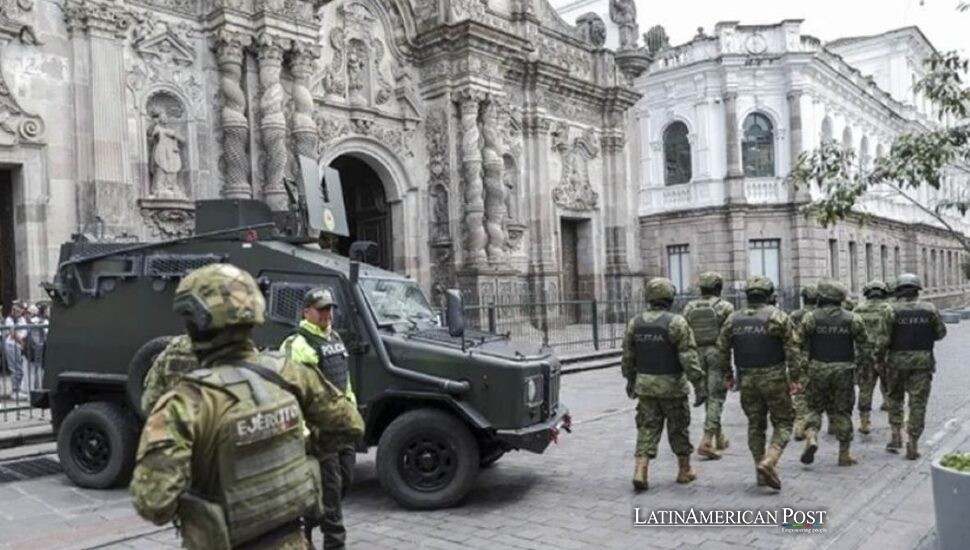
On paper, it is a legal instrument. In ordinary life, it is something else. It is the sound of boots in stairwells, checkpoints on roads, raids that arrive before dawn, families keeping phones charged in case the neighborhood chat lights up with warnings. The decree, cited by EFE, authorizes security forces to act in those territories to protect internal order, restore public security, and prevent or neutralize criminal activity that affects citizens’ rights and freedoms.
It also suspends the inviolability of the home, allowing security forces to enter private residences when they suspect illegal activity. That is the part that lingers. In Latin America, the home has often been the last refuge against both crime and the state. When the state says it may cross that threshold, many citizens hear protection. Others hear memory.
Noboa had said from the United States a month earlier that he would not extend the state of exception then in force since April, according to EFE. “It will not be extended. If we have another period in which we have special operations, we will need a new one, but a new state of emergency,” he said at the time. Technically, this is the new one. Politically, it feels like continuity under another stamp.
The Numbers Behind the Fear
The president’s argument rests on a brutal reality. Ecuador, once seen as a relatively calm country between Colombia and Peru, has become one of the region’s most violent laboratories of criminal power. According to figures from the Interior Ministry cited in the notes, 2025 closed with around 9,300 homicides, a record that placed Ecuador at the top of Latin America’s homicide rate rankings.
That figure is more than a statistic. It means funerals that arrive in clusters. It means schools closing early, shopkeepers paying extortion, and mothers learning which streets not to cross. It also reveals the limits of a hardline strategy that has been escalating since January 2024, when Noboa declared an “internal armed conflict” and reclassified criminal gangs as “terrorists,” linking them mainly to drug trafficking and illegal mining.
The geography of this decree tells its own story. Guayas and Manabí point to ports and coastal routes. Esmeraldas points north, toward Colombia, river corridors, and the long afterlife of armed conflict across a porous border. El Oro looks toward Peru and trafficking routes. Pichincha brings the crisis into the political heart of the country. This is no longer a problem that can be described as coastal violence or frontier insecurity. It is national.
Yet the data also runs counter to the government’s preferred language of battlefield victory. If emergency rule, curfews, military deployments, and terrorist designations were enough, 2025 would not have ended with a homicide record. The state may be more visible, but visibility is not control. Soldiers can enter a neighborhood. They cannot easily rebuild an investigative police force, clean up prisons, protect witnesses, create jobs for young men recruited by gangs, or untangle illicit money from legal businesses.
That is the hard lesson Latin America keeps relearning. Emergency powers can disrupt crime. They rarely dismantle the political economy that feeds it. Gangs thrive where ports move cocaine, illegal mines launder gold, prisons become command centers, and local institutions are too weak or too compromised to resist.
A Border War With Regional Echoes
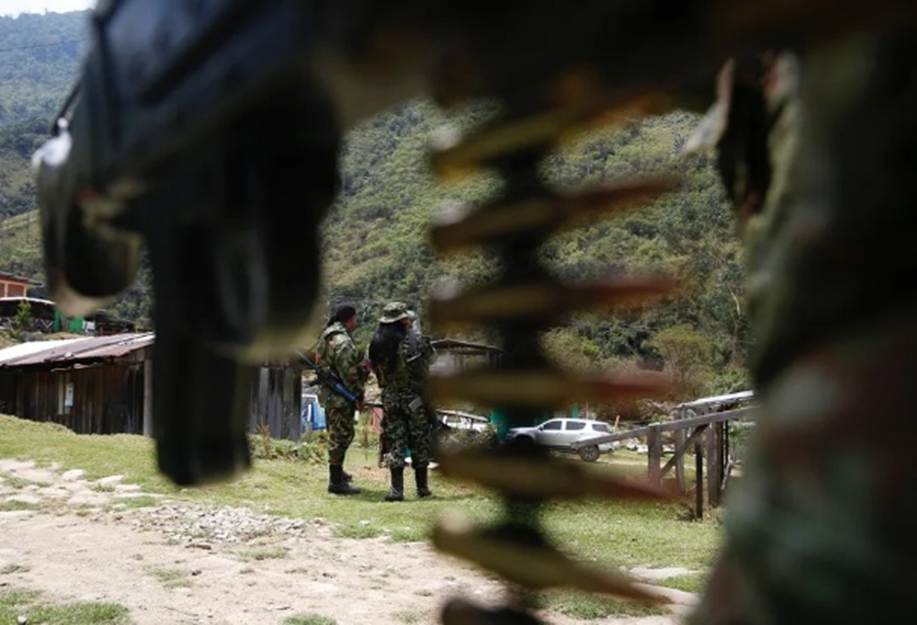
The same day the decree was announced, Ecuador’s Army reported the detention of seven people allegedly linked to the Oliver Sinisterra group, a dissident faction of the former Revolutionary Armed Forces of Colombia, in Eloy Alfaro, Esmeraldas province, along the Colombian border. According to EFE, soldiers seized two rifles, three shotguns, ammunition, tactical equipment, and supplies for staying in the field.
The details are small and large at once. A few rifles in a coastal municipality. A dissident name from Colombia’s unfinished peace. A border province where the forest, rivers, and sea can serve both families and traffickers. The arrest suggests why Ecuador’s crisis cannot be fenced inside Ecuador. Its violence belongs to a regional circuit that runs through coca economies, maritime routes, illegal mining, prison networks, and the demand for drugs far beyond Latin America.
On Monday, Esmeraldas was also the setting for combined river operations and training between Ecuador and the United States. Ecuador’s Defense Ministry said personnel from Marine Infantry Battalion 11 San Lorenzo and the U.S. Armed Forces’ Special Boat Team 22 carried out river reconnaissance, tactical navigation, and response procedures for risk scenarios, according to EFE.
Washington’s support is not new, and for Ecuador, it may be necessary. But it also carries Latin America’s old unease. The region has a long memory of foreign security partnerships that promise capacity and leave behind dependency, political backlash, or militarized shortcuts. The challenge for Noboa is to accept help without turning Ecuador’s crisis into another chapter of imported doctrine and domestic exception.
For Latin America, Ecuador is now a warning flare. The country shows how quickly organized crime can convert geography into power and institutional weakness into territory. It also shows how democratic governments, pressured by terrified citizens, can slide into emergency-only governance because normal tools seem too slow.
Noboa’s gamble is that extraordinary powers can buy time. The danger is that they become the political weather. Once citizens grow used to states of exception, leaders may find it easier to renew them than to explain why murder remains high despite them. Crime then reshapes democracy twice: first by terrifying the public, then by teaching governments to rule around ordinary limits.
Ecuador needs security. That part is not abstract. People want to live, work, travel, and sleep without negotiating with armed men. But the deeper test is whether Noboa can turn emergency pressure into institutional strength, not simply another 60-day cycle. Latin America is watching because the question is bigger than Ecuador: can a democracy fight criminal armies without slowly resembling a barracks?
Also Read: Chaco War Ghosts Teach Bolivia and Paraguay Peace Still Pays