La Guaira Listens for Life as Venezuela’s Quake Grief Deepens
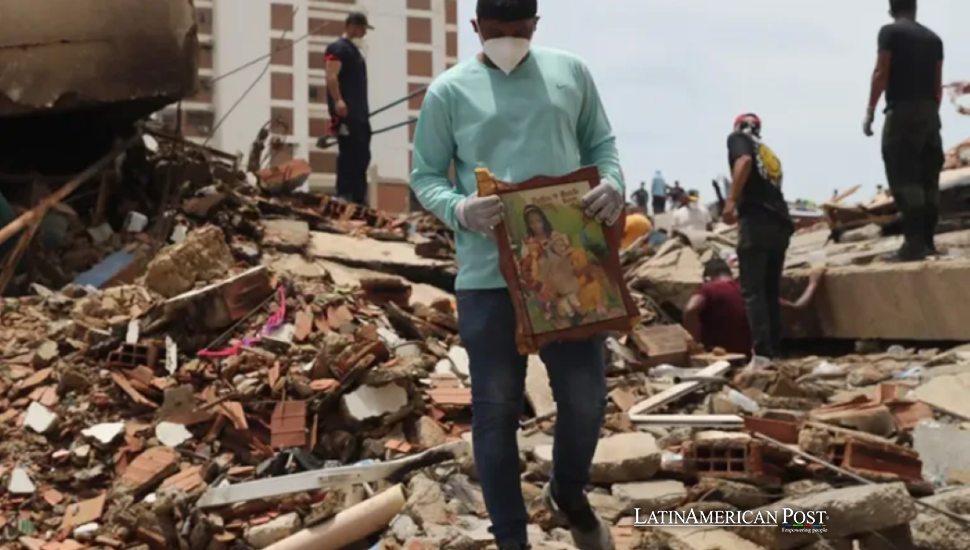
Six days after twin earthquakes battered Venezuela’s Caribbean coast, La Guaira has become a geography of silence, rubble and stubborn hope, where rescuers pause traffic, families hold breath and every faint scrape beneath concrete can still rearrange grief into life.
When Silence Becomes a Tool
The command travels faster than machinery. “Silence.”
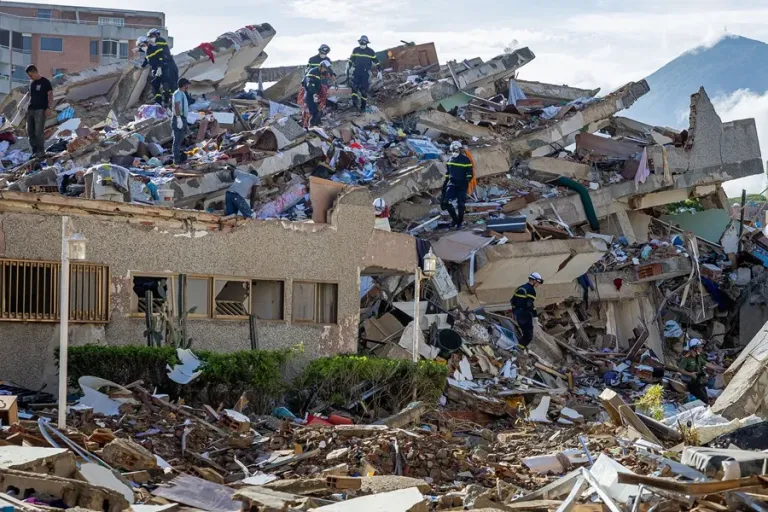
A fist rises. Engines die. Conversations collapse into whispers, then into nothing. Along the coastal towns of La Guaira, the Venezuelan state most devastated by last Wednesday’s twin earthquakes, silence has become a rescue instrument, as necessary as cranes, dogs, helmets and hands. It settles over ruined apartment blocks in Caraballeda and Catia La Mar with a strange weight, demanding obedience from everyone nearby: firefighters, police officers, soldiers, relatives, drivers, neighbors staring through dust.
For several minutes, nobody moves. Nobody coughs if they can help it. On the main road, cars and motorcycles sit in long frozen lines because state security officials have ordered engines turned off. The living must go quiet so the trapped might speak.
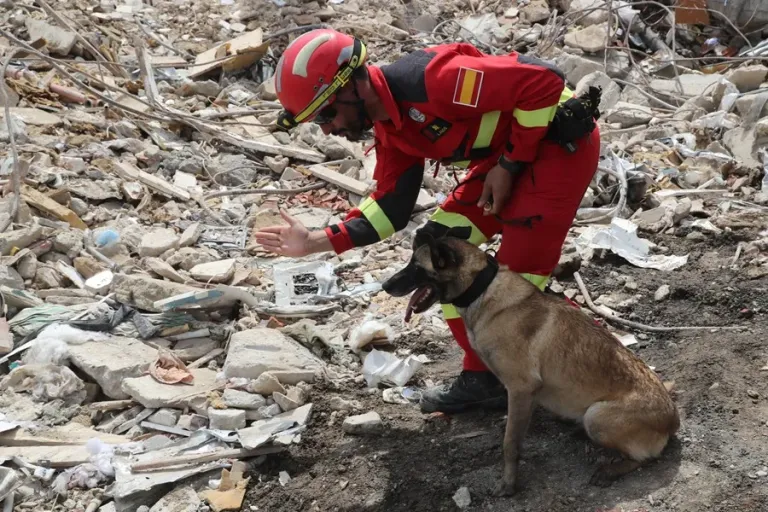
“When we ask for silence, it is very important because at that moment we place the geophones,” Spanish military officer Alberto Vázquez, part of Spain’s Military Emergency Unit deployed in Venezuela since Friday, June 26, told EFE.
The device, he explained to EFE, is placed on concrete. If a victim trapped below scratches a wall with their knuckles or makes the slightest movement, rescuers may hear it. But the machine is also fragile in its own way. A footstep outside, a passing vehicle, or a careless sound can distort the signal and produce a false positive.
In La Guaira now, hope has rules. Hope must be quiet. Hope must wait.
The disaster began on Wednesday, June 24, when two powerful earthquakes, magnitude 7.2 and 7.5, struck northern Venezuela west of Caracas. By the sixth day of search efforts, Venezuelan government figures put the toll at least 1,943 dead and more than 10,500 injured. Doctors, rescuers, and military personnel say the odds of finding survivors are shrinking. Families know this. They can read faces. Still, they remain near the ruins because absence is not the same as death until someone says so with certainty.
The Coast That Broke
La Guaira is not just a coastline. It is Caracas’s edge, its humid escape, its port, its memory of beach weekends and steep mountain roads. Its towns sit between the Caribbean Sea and the coastal range, a beautiful geography that can become merciless when the earth convulses. In this disaster, geography mattered as much as the shaking.
The U.S. Geological Survey warned that landslides triggered by the earthquakes would likely be numerous or extensive. Later satellite assessments suggested the overall landslide damage may not be as severe as initial models predicted, but that distinction offers little comfort in the hardest-hit places. The mountains above La Guaira, Macuto,, and Caraballeda have experienced widespread, major landslides. Structures in Catia La Mar and Playa Grande have been buried, damaged, or struck. Coastal roads west of Catia La Mar have been hit, while rockfall and boulders appear to be among the most serious road obstructions.
That means the earthquake is not over the way people want disasters to be. Aftershocks and rain can still loosen slopes. Roads can remain blocked. Inland communities may be cut off from the coast. Rescue does not happen only at collapsed buildings. It happens on broken roads, near unstable hillsides, around hidden power lines, and under the constant threat that loosened earth may move again.
The numbers show the size of the response and also its limits. According to Venezuelan government figures, 6,461 people have been rescued. In the disaster zone, authorities say there are 3,660 foreign rescuers, 148 dogs, 49 support vehicles, and 26,121 Venezuelan personnel. Those figures suggest a massive, internationalized, militarized mobilization, but they also reveal the scale of the wound. Tens of thousands of responders still cannot make concrete speak faster.
At the Caribe residential complex in Caraballeda, searches unfold in several sectors at once. The Bolivarian National Police, the forensic police, military personnel, and rescue teams divide the collapsed buildings into zones, calling to one another when they believe they may have found a sign. Nearby, other teams continue working through residences in Caraballeda and Catia La Mar, the names now repeated like a litany of damage.
There are moments when the scene feels almost impossibly modern: geophones, satellite imagery, international rescue units, coordinated teams. Then a hand appears with a bucket. A relative calls a missing person’s name. Someone wipes dust from a photograph found in debris. Latin America knows this overlap too well: the sophisticated and the precarious working shoulder to shoulder because public infrastructure often arrives late, thin, or uneven, while families arrive first.
Politics Under the Rubble
Disaster in Venezuela is never just a disaster. It lands on a country already strained by institutional mistrust, economic collapse, migration, sanctions, polarization, and exhaustion. The earthquake did not create the country’s fractures, but it exposed them with cruel clarity.
Jorge Rodríguez, president of Venezuela’s National Assembly, urged rescuers to keep searching. “We have to remain in the relentless search for people alive. We have to remain in the hope of continuing to find people alive under the rubble,” he said, according to EFE.
Hope, however, has become contested terrain. Venezuelan authorities have not been updating the number of missing people, even as organizations and support networks try to locate relatives. Opposition leader María Corina Machado has promoted a website developed by technicians and civil society so people can report missing family members. So far, the platform registers 42,664 people who have not established contact with loved ones.
That number is not the same as a confirmed death toll or official missing list. Communications fail after catastrophes. Families scatter. Phones die. Roads close. Yet the figure still matters because it measures anguish. It also measures a credibility gap. When the state does not provide timely missing-person updates, civil society fills the silence with spreadsheets, forms, names, and fear.
There is an uncomfortable parallel beyond Venezuela. Around the world, powerful institutions often insist that rules apply equally, even when conditions say otherwise. Iran’s World Cup experience, shaped by U.S. restrictions that reportedly forced the team into a border-camp arrangement in Tijuana, raised a sports version of the same problem: a formally shared stage can still become a non-level playing field when politics controls movement, logistics and access. In La Guaira, the imbalance is not athletic but civic. Families facing grief need information, roads, hospitals, and trustworthy channels. Without them, survival itself becomes uneven.
For now, the coast listens. A fist rises. The machines pause. Somewhere below concrete, maybe, there is a tap, a scrape, a last argument with darkness. La Guaira waits for that sound, because on the sixth day of searching, silence is no longer emptiness. It is the thinnest place where life might still answer.
Also Read: Venezuela Earthquake Diplomacy Turns Rubble Into a Rare Political Bridge