Mental Health: Venezuela Earthquakes Keep Shaking Families After the Ground Goes Still
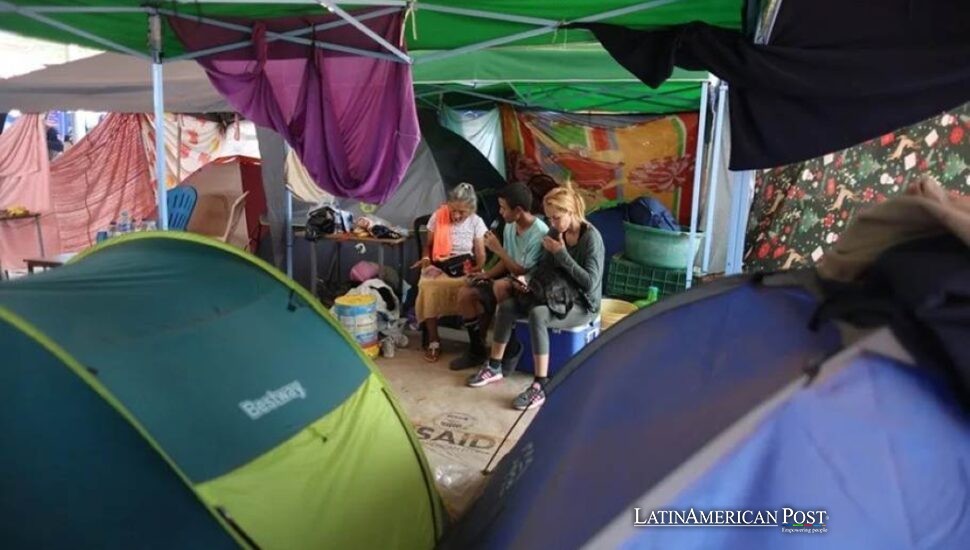
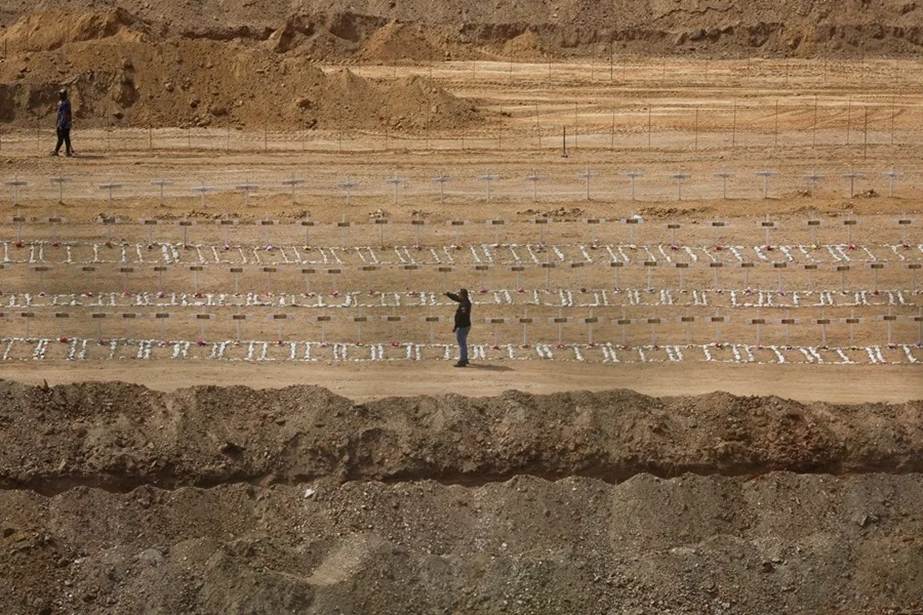
After twin earthquakes killed 3,899 people in Venezuela, survivors face a quieter emergency: sleepless children, phantom swaying and ordinary rooms transformed into danger. In Caracas, outdoor mental health teams are helping families name fear before it hardens into lasting trauma.
When the Body Keeps Moving
On the sixth floor of her Caracas apartment building, Rosmery Mujica has learned that safety and calm are not the same thing. Her home survived the twin earthquakes. No wall opened. No relative was counted among the dead. Still, night arrives, and her body refuses the evidence around her.
She cannot sleep. Her 2-year-old daughter, Cataleya, cannot settle either. The child turns restless, and Mujica feels fear return, not through the floor this time, but through the body beside her.
“We have been under tension for a long time, and the earthquake has shaken many things within us; it’s as if we just exploded,” the mother told EFE. She called the disaster “the final straw,” landing on political uncertainty, social strain and the exhaustion of raising a child where crisis has become less an episode than an atmosphere.
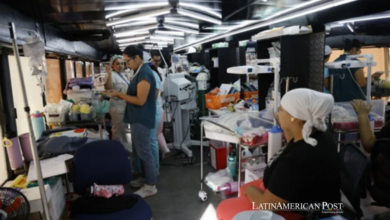
Mujica’s realization came in a circle of mothers seated outdoors at an AECID field hospital in a Caracas park. As the woman spoke, she began to see Cataleya’s fear reflected back at her.
“My daughter is extremely nervous, but right now I’m realizing that it’s mostly me; I’m the one transmitting the nerves to her,” she told EFE.
That confession carried no failure. Parents regulate a room before children have language for it. After a disaster, a mother’s breathing and watchfulness can become a second seismograph. The child reads the parent, and fear circulates through the household.
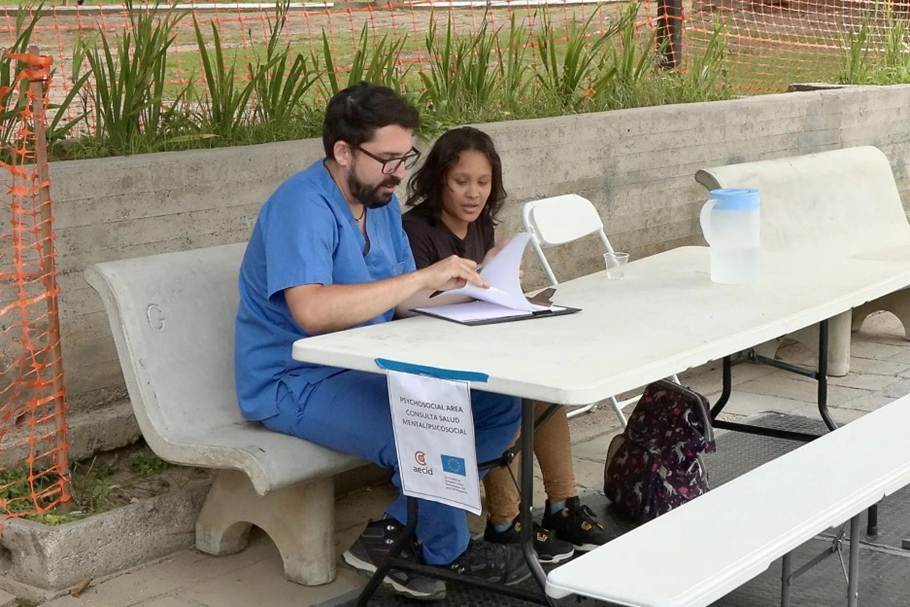
Psychologist Jaime Gálvez sat with Mujica and three mothers among benches and outdoor chairs. For days, he has met survivors outside. People can arrive carrying a baby, sit down, speak, and discover that panic has a grammar.
“The most important thing is that you have to take care of yourselves,” Gálvez told the group, according to EFE. “You have the right to be well, you have the right to feel bad, to have a bad day, but above all, you have the right and the duty of self-care.”
The wording matters in Venezuela. Self-care can sound indulgent for families who have spent years improvising amid scarcity, unstable services, political confrontation, and relatives who have migrated. Yet untreated fear does not remain private. It reaches children’s sleep.
A Crisis Before the Crisis
The earthquakes did not strike a psychologically blank landscape. Mujica’s phrase, “the final straw,” explains why the same tremor can produce different aftershocks inside different people. Disaster arrives at a moment in both life and country. It meets whatever is already there.
Venezuela’s national emergency has trained many citizens to live in anticipation. Prices change, plans collapse, relatives leave, institutions become harder to trust. That uncertainty is not an earthquake, but both unsettle the promise that tomorrow will resemble today. Together, they can make vigilance feel rational after danger has passed.
Gálvez told EFE that his team has mainly treated acute stress and, in some cases, chronic stress. Their goal is to keep those reactions from consolidating into post-traumatic stress disorder. Psychiatrist Ricardo Arjona told EFE that intervention is crucial because PTSD becomes much harder to treat once established.
The symptoms are stubbornly physical. Some survivors cannot sit on the sofa where they felt the room move. Others avoid the staircase where they believe they might die while evacuating. A familiar sound can trigger the body before the mind interprets it.
“When a catastrophe or an unexpected crisis occurs, the brain enters a state of alert,” Gálvez told EFE. In the following days, he said, images return in disorder. Noises resemble warnings. A smell can feel like evidence. The nervous system is trying, too aggressively, to prevent a second surprise.
Treatment begins by helping people “unblock what they are experiencing,” Gálvez explained to EFE. A passing truck, slammed door, or strange odor does not announce another earthquake. Sitting again on the sofa, briefly at first, can give the body a new memory.
The advice can sound modest: move the body, lower stress, rebuild routines, seek professional care. But simplicity is not ease. Routine after a catastrophe is reconstruction. Breakfast at the usual hour, a walk, a child’s bath, one night back in the bedroom. Each repetition tells the brain the world has not ended again.
For a public health system under pressure, this work has national consequences. Lasting trauma can diminish a person’s ability to work, care for children, study, or return home. In a country carrying deep social costs, mental health is not a private luxury. It is part of recovery.
Resilience Without Romance
Solimar Monroy arrived, fearing her own body had become unreliable. The 22-year-old mother had felt a swaying sensation for about five days, as if the ground had continued inside her. Speaking with EFE, she moved her arms and torso to demonstrate it.
After a severe panic attack, she thought she was losing her mind. The “shakes” seemed impossible to explain. Her mother urged her to seek help. While breastfeeding her infant daughter, Monroy listened as Gálvez connected the sensation to nerves and anxiety she had experienced before the disaster.
Slowly, the feeling acquired a frame. It could pass. It did not mean madness. It did not mean the earth was moving.
“I imagine I’m not the only person who has felt this,” Monroy told EFE.
That sentence offers relief after collective trauma. Isolation magnifies symptoms. Shared language reduces their mystery. Gálvez said people need to express what happened and have it validated by a professional, a neighbor, a colleague, or a mother.
The communal instinct has surprised him. A Spanish psychologist who has worked in other emergencies, including the 2024 floods in eastern Spain, Gálvez told EFE he has seen striking mutual care and resilience in Venezuela.
His praise should be heard carefully. Latin Americans are often celebrated for resilience precisely when institutions fail to provide enough protection. The compliment can become a trap, turning endurance into an excuse for abandonment. Venezuelans should not have to be endlessly capable of absorbing the next blow.
Still, resilience is real when understood not as cheerful toughness but as practiced social knowledge. It is the mother who notices another mother’s sleeplessness, the neighbor who sits through the retelling, the psychologist working from a park bench because that is where people can be reached.
Gálvez told EFE that Venezuelans were already accustomed to different catastrophes, social changes, and political shifts. His task, he said, is to remind them of their capacity for resilience and empowerment.
The deeper challenge is to make that capacity less necessary. Mental health teams can help families return to sofas and staircases, but they cannot remove the conditions that made the earthquake feel like an explosion after years of tension. Recovery requires care close to home, trusted institutions, and time without another emergency.
For Mujica, the work begins at night. She watches Cataleya, then watches herself. The apartment is standing. The floor is still. Yet calm must be rebuilt slowly inside the body, one breath and one ordinary evening at a time.
Also Read: Trinidad’s Quake-Raised Coast Turns Fool’s Gold into Warning Signs Today